

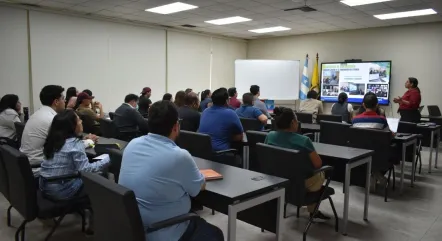
 FICT Strengthens Its Commitment to Waste Reduction and Responsible Waste Management
FICT strengthened the culture of sustainability within its community through a workshop on inclusive recycling and responsible waste management, promoting practices of waste reduction, sorting, and proper disposal that contribute to a more sustainable and responsible campus.
 FICT Researcher Leads Editorial Board on Volcanoes in Ecuador and the Northern Andes
Maurizio Mulas, Ph.D., a professor and researcher at FICT-ESPOL, serves as the lead editor of the “Volcanoes of Ecuador and the Northern Andes: Eruptive Dynamics, Hazards, and Societal Impact” Topic Editorial Board for Frontiers in Earth Science. This editorial initiative aims to bring together research on eruptive dynamics, magmatic systems, volcanic monitoring, and hazards associated with the volcanoes of Ecuador and the Northern Andes. His participation strengthens ESPOL’s presence in international scientific communities, promotes exchange among researchers, and helps position research conducted in Ecuador within regional discussions on volcanic processes and risk management.
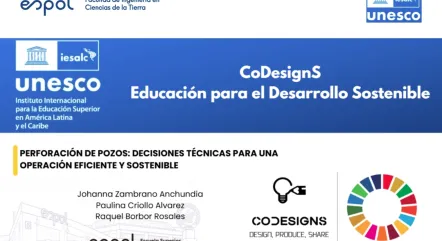 Sustainability is also evolving in the classroom
Professor Johanna Zambrano, from the Petroleum Engineering program at FICT, completed the Bootcamp on Instructional Design and Education for Sustainable Development, organized by UNESCO IESALC. During this regional program, participants from Latin American universities worked on tools to integrate sustainability across all areas of higher education. As part of the program, Johanna Zambrano, along with Paulina Criollo and Raquel Borbor Rosales, participated in the pedagogical redesign of the Drilling course, incorporating strategies that link technical content with impact analysis, decision-making, collaborative work, and the search for responsible solutions. The initiative helps strengthen a university education that integrates technical, environmental, social, and economic dimensions.
 FICT Announces the Students Selected for the “VIVA FICT Engineering Pioneers” International Mobility Program
FICT selected 11 students from the Civil Engineering, Mining, Geology, and Petroleum Engineering programs to participate in the VIVA FICT Engineering Pioneers program, an international experience that will strengthen their academic, professional, leadership, and intercultural skills through activities during a stay in Madrid, Spain.
 ESPOL research in Santa Elena contributes to the IAEA's global study on emerging contaminants and water quality.
ESPOL participated in a project coordinated by the International Atomic Energy Agency (IAEA) to improve the identification of sources of nitrate pollution and emerging contaminants in surface and groundwater. The Ecuadorian study was conducted primarily in Chanduy, Santa Elena, where six sampling campaigns were carried out between 2022 and 2025, incorporating physicochemical, hydrochemical, and isotopic analyses. The combination of nitrate isotopes and emerging contaminants provided information to distinguish between possible sources of pollution associated with agricultural and domestic activities, as well as other land uses.
 FICT Community Presents 21 Research Projects at Pares o Nones 2026
FICT participated in Pares o Nones 2026 with 21 research projects presented by 18 researchers from various fields, highlighting the diversity and multidisciplinary nature of its scientific output and creating new opportunities for academic and scientific collaboration.
 FICT promotes iPEER certification to strengthen teacher development and quality education
FICT promotes the iPEER international certification among its academic community to strengthen faculty professional development, recognize the competencies of its engineering educators, and promote continuous improvement in teaching and learning processes in STEM programs.
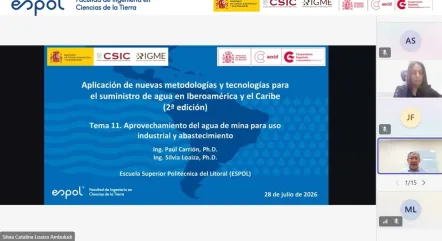 FICT promotes the sustainable use of mine water in Ibero-America and the Caribbean through innovative initiatives
FICT-ESPOL participated in the second edition of the international program “Application of New Methodologies and Technologies for Water Supply in Ibero-America and the Caribbean,” with the presentation “Utilization of Mine Water for Industrial Use and Water Supply,” delivered by Paúl Carrión, Ph.D., and Silvia Loaiza, Ph.D. The training session brought together nearly 80 participants from Latin America and the Caribbean and provided an opportunity to share strategies, technologies, and case studies developed in Ecuador for the treatment and sustainable use of mine water. This participation strengthened the international exchange of knowledge on water security, environmental management, and the use of water resources in mining contexts.
 FICT is participating in the Competency-Based Curriculum Design Process to strengthen ESPOL's degree programs
The participation of FICT faculty members in the competency-based curriculum design process strengthened their ability to design and update academic programs, promoting relevant, high-quality university education aligned with professional competencies.
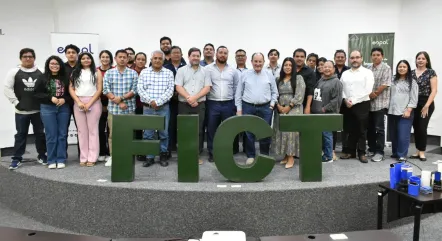 A conference at FICT introduces students and professionals to trenchless technologies for the rehabilitation of water and sanitation networks
FICT-ESPOL organized a technical conference on trenchless technologies for the rehabilitation of water and wastewater networks, aimed at students and professionals. During the event, solutions such as CIPP, spiral winding, flexible sleeves, pipe bursting, and horizontal directional drilling were presented, all designed to reduce project durations, urban impacts, and rehabilitation costs. The case of the Parson Sur sanitary sewer in Guayaquil was also discussed to analyze the challenges of the existing sanitary infrastructure and potential intervention options. The event strengthened the technical training of the civil engineering community through exchanges with specialists from industry and the public sector.