

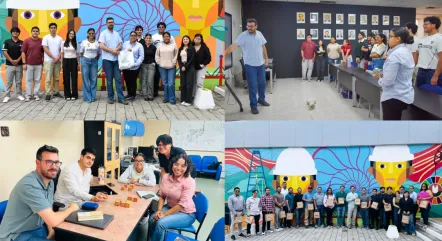
 FICT Promotes Innovation in Structural Engineering Through an International Course in Partnership with the Polytechnic University of Catalonia
FICT–ESPOL successfully concluded the course “Traditional and Contemporary Structures: Inspection, Monitoring, and Digital Techniques (DIC and Photogrammetry),” held as part of the Erasmus+ KA171 program. The training strengthened the skills of students and professionals in advanced technologies for structural assessment and reinforced academic cooperation between ESPOL and the Universitat Politècnica de Catalunya.
 ESPOL's FICT inspires future generations and brings the geosciences closer to students in Zaruma through interactive experiences
FICT–ESPOL held an academic outreach event at educational institutions in Zaruma to introduce high school students to the world of geosciences through hands-on activities related to geology and mining. The initiative promoted career guidance, scientific outreach, and the strengthening of ties between the university and the community.
 Technical presentation on optimizing hydrocarbon production processes enhances the knowledge of petroleum engineering students.
The SPE–ESPOL Student Chapter held a technical presentation titled “Production Optimization Through Re-fracturing and Stimulation,” aimed at students in the Petroleum Engineering program at FICT. The presentation provided insight into techniques used in the industry to optimize hydrocarbon production and strengthened the link between academic training and professional practice.
 More than 60 FICT graduates complete their academic studies as part of the 2026 Collective Graduation Ceremony
More than 60 students from FICT–ESPOL joined the workforce as new professionals during the 38th graduating class ceremony. The ceremony recognized the academic excellence of the top graduates from each program and reaffirmed the school’s commitment to training professionals who contribute to the country’s sustainable development.
 FICT Faculty Members Selected as Early-Career Editorial Board Members for Scientific Journals Indexed in Scopus
Professors and researchers Andrés Velástegui and Priscila Valverde were selected as Early-Career Editorial Board Members for international scientific journals indexed in Scopus and ranked in the Q1 quartile, thereby strengthening FICT-ESPOL’s presence in high-impact academic networks. Their appointment to these editorial boards will contribute to the management and dissemination of scientific knowledge, as well as to the strengthening of international research collaboration.
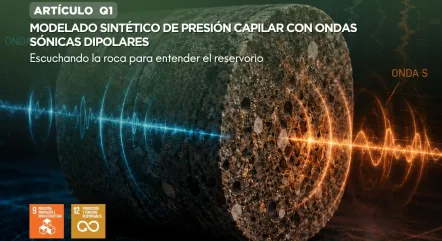 FICT researchers develop an innovative methodology for characterizing reservoirs using sonic logs
Researchers at FICT–ESPOL developed an innovative methodology that uses dipolar acoustic logs to generate synthetic capillary pressure curves and characterize reservoirs with limited data. Published in *Scientific Reports*, the study provides a tool to support reservoir engineering and strengthens applied research in the energy sector.
 ESPOL and EPAMIL are strengthening their partnerships to advance the ECU7010 project on groundwater monitoring
Researchers from FICT and technicians from EPAMIL have formed a partnership to advance the ECU7010 project, which will apply isotopic techniques to the study of the Chobo aquifer in order to strengthen groundwater monitoring. This collaboration will generate scientific information to support sustainable water resource management and improve decision-making regarding the drinking water supply in Milagro.
 FICT promotes the appreciation of Ancón's oil heritage through community service initiatives
Students and professors from the Petroleum Engineering program at FICT–ESPOL conducted a technical visit to old oil wells in San José de Ancón to assess their heritage value. The activity reinforced the students’ practical training and provided technical criteria to promote the preservation of industrial heritage and the development of a heritage trail.
 FICT Professor Discusses Technologies to Reduce the Impact of Earthquakes in an Interview
Walter Hurtares Orrala, an engineer and professor at FICT–ESPOL, participated in El Foro Tech to explain how civil engineering and structural monitoring technologies help reduce seismic risk and strengthen building safety. During the interview, he highlighted the importance of earthquake-resistant design, updating codes, and using innovative tools to build more resilient cities.
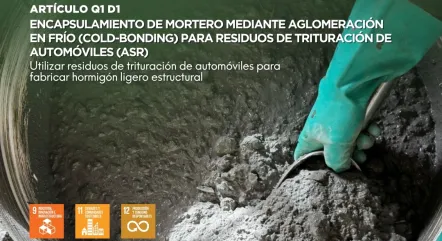 ESPOL and UPC Transform Automotive Waste into Sustainable Construction Materials
Researchers from ESPOL and the Polytechnic University of Catalonia developed a method for transforming automotive shredder waste into lightweight aggregates for structural concrete. Published in a Q1/D1 scientific journal, the study promotes the circular economy and the development of sustainable materials for the construction industry.