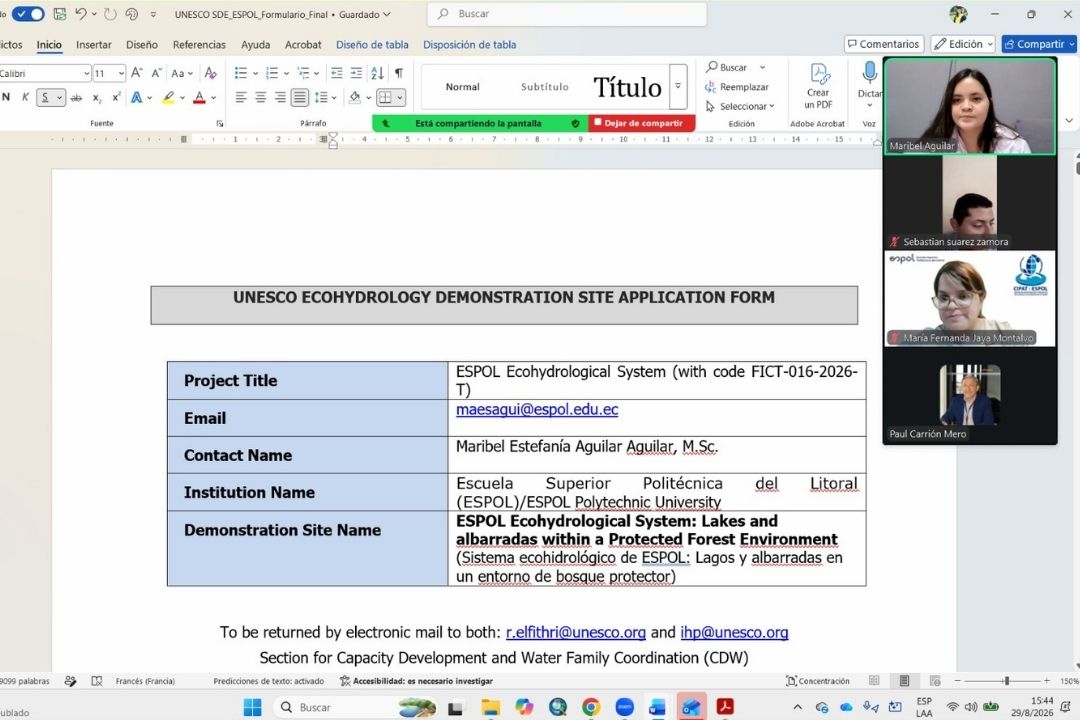


On August 29, 2026, ESPOL submitted to UNESCO the proposal “ESPOL’s Ecohydrological System: Lakes and Dikes in a Protective Forest Environment,” with the aim of establishing the Gustavo Galindo Velasco campus as an Ecohydrology Demonstration Site. The initiative seeks to highlight the campus’s system of lakes and irrigation ditches—in interaction with the protective forest—as a living laboratory to strengthen sustainable water management, ecosystem conservation, and socio-environmental resilience.
The proposal was developed through the participation of administrators, professors, researchers, technical staff, administrative personnel, and students from various faculties, research centers, and institutional units at ESPOL, as well as student chapters and national and international partners. As part of this process, a meeting was held on August 26 at the FICT to review and validate the final version of the proposal, incorporating input from the various participating units.
Institutional coordination made it possible to integrate capabilities related to the monitoring and modeling of water resources, biodiversity, nature-based solutions, ecological restoration, infrastructure, environmental management, education, responsible tourism, innovation, and sustainability. Student chapters also supported the nomination, strengthening student participation in an institutional vision that links campus conservation with sustainable water management.
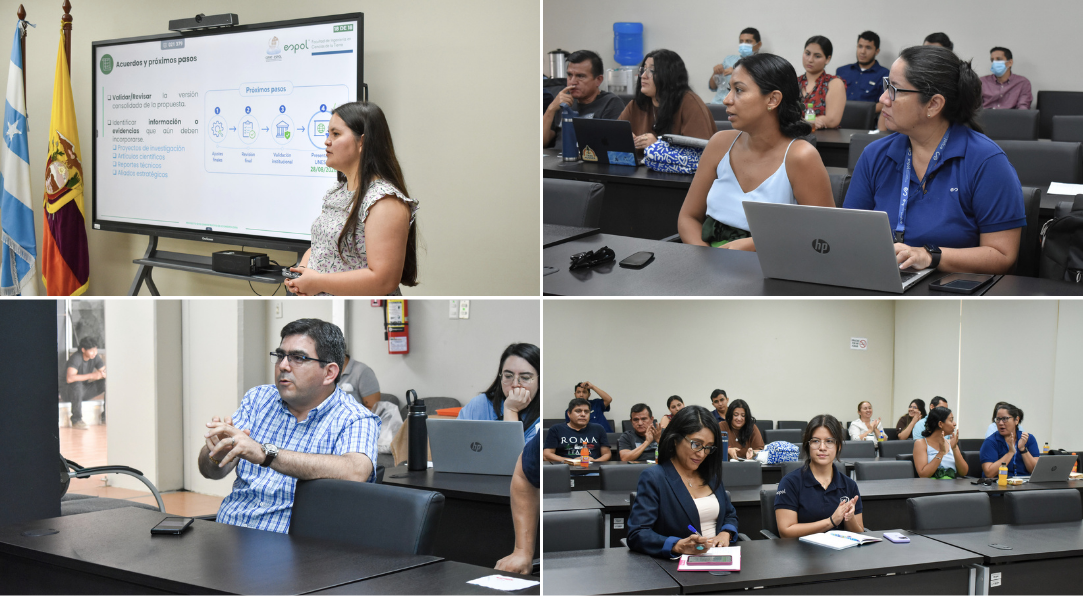
This work was supported by more than 15 national partners and more than 7 international partners, all linked to ESPOL through activities in research, cooperation, environmental management, ecohydrology, and sustainable development. This collaboration highlights the institutional and multidisciplinary nature of the proposal, which goes beyond the work of a single research group and brings together the capabilities of the polytechnic community and its collaborative networks.
The proposal recognizes the role of lakes and earthen dams in water retention and availability, water regulation, support for biodiversity, and forest conservation. It also considers the functions of the Prosperina Protective Forest and Vegetation in soil protection, runoff regulation, infiltration, ecological connectivity, and species conservation.
The nomination is supported by the research project “ESPOL Ecohydrological System,” code FICT-016-2026. Its submission to UNESCO represents a step toward raising international awareness of ESPOL’s capabilities in ecohydrology, sustainable water management, ecosystem conservation, and the development of solutions based on scientific knowledge.
🔗 YouTube Ecohydrology Demonstration Site Project
Institutional and student stakeholders who participated in the proposal
Prosperina Forest and Vegetation Reserve
Faculty of Geosciences Engineering (FICT), ESPOL
Faculty of Life Sciences (FCV), ESPOL
Faculty of Maritime Engineering and Marine Sciences (FIMCM), ESPOL
Faculty of Natural Sciences and Mathematics (FCNM), ESPOL
Faculty of Mechanical Engineering and Production Sciences (FIMCP), ESPOL
Faculty of Social Sciences and Humanities (FCSH), ESPOL
School of Art, Design, and Audiovisual Communication (FADCOM), ESPOL
Center for Research and Applied Projects in Earth Sciences (CIPAT), Escuela Superior Politécnica del Litoral (ESPOL)
UNESCO Chair in Geosciences Applied to Sustainable Development
Georesources and Applications Research Group (GIGA), ESPOL
Center for Water and Sustainable Development (CADS), ESPOL
Center for Rural Research (CIR), ESPOL
Sustainability, ESPOL
Infrastructure, ESPOL
Administrative Management, ESPOL
Sustainable Development Club (CDS)
Student Chapter of the American Association of Petroleum Geologists (AAPG)
Student Chapter of the American Concrete Institute (ACI)
Student Association of the School of Earth Sciences Engineering (AEFICT)
Student Chapter of the American Society of Civil Engineers (ASCE)
Student Chapter of the International Association for Hydro-Environment Engineering and Research (IAHR)
Student Chapter of the Society for Mining, Metallurgy & Exploration (SME)
Student Chapter of the Society of Petroleum Engineers (SPE)
Related Sustainable Development Goals
SDG 6: Clean Water and Sanitation, for its contribution to the sustainable management of water resources through the study and enhancement of the campus’s ecohydrological system.
SDG 11: Sustainable Cities and Communities, for the development of knowledge and solutions aimed at strengthening socio-environmental resilience and sustainable land management.
SDG 15: Life on Land, for the conservation of biodiversity, ecosystems, and the Prosperina Protected Forest and Vegetation Area.