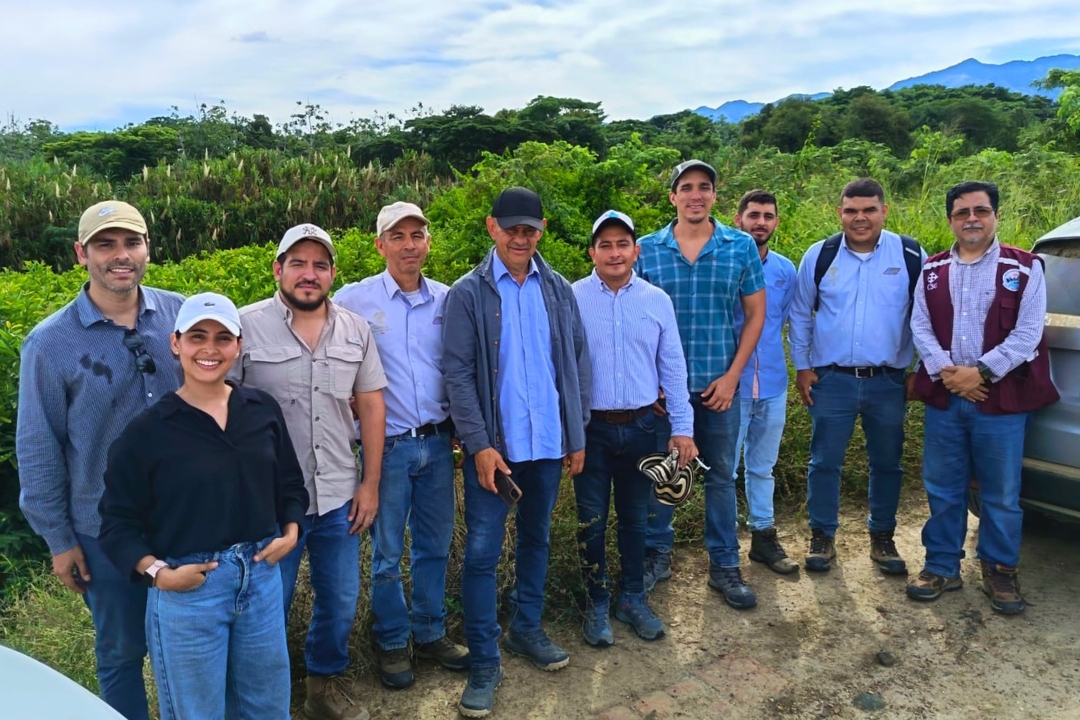


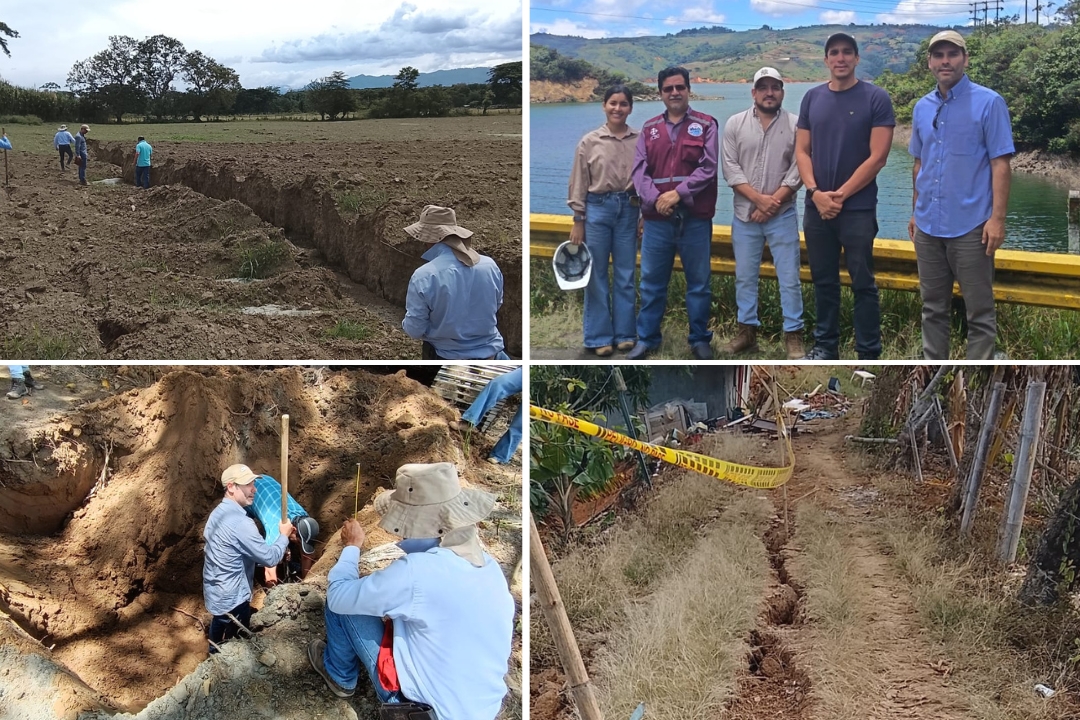
A commission of specialists from the Faculty of Geosciences Engineering (FICT) at the Escuela Superior Politécnica del Litoral (ESPOL) and the Catholic University of Santiago de Guayaquil (UCSG), in coordination with Ecuador’s Ministry of Infrastructure and Technology (MIT), participated in a technical assessment mission in Colombia, following the 7.4 Mw earthquake recorded on August 10, 2026, in San José del Palmar. The inspections took place from August 17 to 21 in areas of Cali, along the Cali–Darién–Guadalajara de Buga highway, and along the banks of the Cauca River in Roldanillo, Pereira, and Manizales.
The mission’s objective was to inspect and document ground failure mechanisms that affected road infrastructure, flood control works, and structures located on slopes. In addition, together with structural engineers, the delegation documented damage to urban buildings related to potential soil-structure interaction and site effects.
During the tour, the delegation documented geotechnical phenomena such as soil liquefaction, lateral spreading, and slope stability. The work received technical support from CENTRA Ingeniería y Construcción and on-site collaboration from the Valle del Cauca Regional Autonomous Corporation (CVC), the Association of Users of the Land Improvement District of the Municipalities of Roldanillo, La Unión, and Toro (ASORUT), and the Risaralda Regional Autonomous Corporation (CARDER).
La comisión estuvo integrada por Ing.Davide Besenzon,Ph.D., especialista en Geotecnia de ESPOL; Ing.Guillermo Ponce,M.Sc., especialista en Geotecnia y Estructuras de la UCSG; Ing.Daniel Falquez,Mgtr., especialista en Geotecnia de ESPOL; Ing.Carlos Grau,M.Sc., especialista en Geotecnia de la UCSG; y Ing.Nathalia Ordoñez,M.Sc., especialista en Geotecnia de CENTRA Ingeniería y Construcción, Colombia.
The information gathered during the mission will serve as the basis for studies on the geotechnical and structural response to severe seismic events. This experience strengthens the link between academic research and professional civil engineering practice, as well as inter-institutional cooperation for the analysis and management of risks associated with seismic events.
Representatives and strategic partners:
Davide Besenzon, Ph.D., (Geotechnical Engineer, ESPOL)
Guillermo Ponce, M.Sc., (Geotechnical and Structural Engineer, UCSG)
Daniel Falquez, Mgtr. (Geotechnical Engineer, ESPOL)
Carlos Grau, M.Sc., (Geotechnical Engineer, UCSG)
Nathalia Ordoñez, M.Sc., (Geotechnical Engineer, CENTRA Engineering and Construction, Colombia)
Related Sustainable Development Goals
SDG 9: Industry, Innovation, and Infrastructure. For contributing to the study of resilient infrastructure and the development of technical knowledge regarding seismic events.
SDG 11: Sustainable Cities and Communities. For contributing to the understanding of failure mechanisms and damage associated with natural events, thereby strengthening risk management and resilience.
SDG 17: Partnerships for the Goals. For promoting cooperation among academic institutions, public entities, and technical organizations in Ecuador and Colombia.