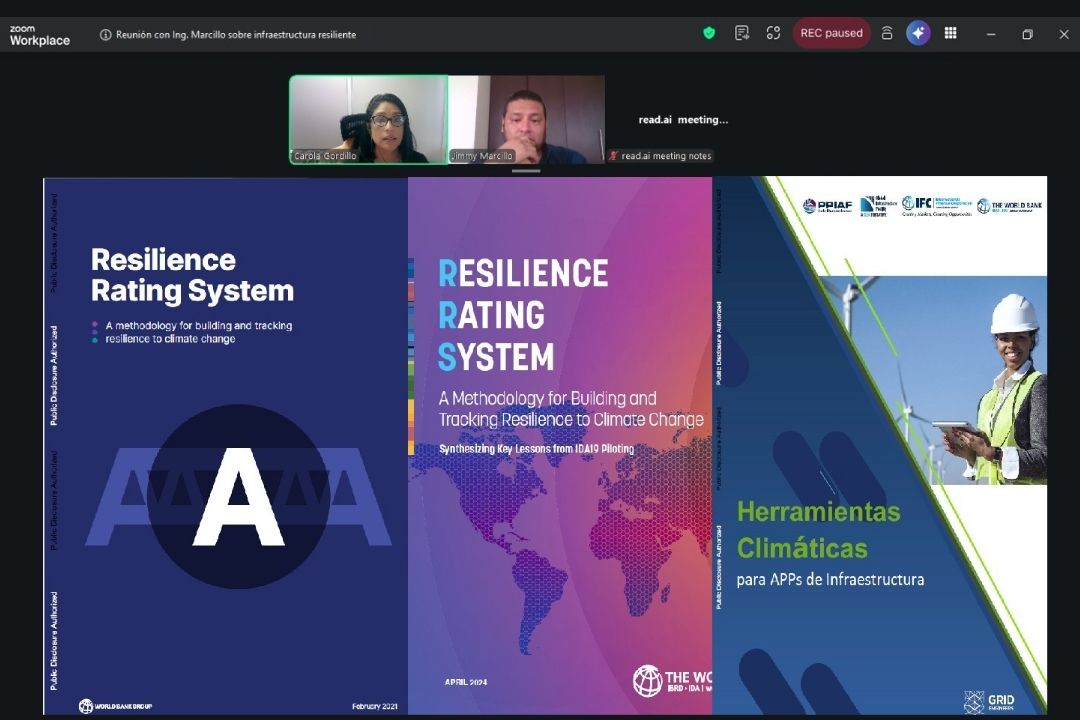


ESPOL’s Faculty of Geosciences Engineering (FICT) participated in a technical meeting aimed at analyzing the results of applying climate resilience criteria to road infrastructure projects. The meeting was held virtually on August 24, 2026, and focused on the experience of the project “Consultancy on Resilience of Road Projects, Study of Roads and Bridges: Resilient Rural Roads P504400 BM,” funded by the World Bank.
During the meeting, which included the participation of Carola Gordillo, M.Sc., a professor in the Civil Engineering program at FICT-ESPOL, Jimmy Marcillo, a specialist from the Implementing Unit and project manager, presented the main findings and recommendations resulting from the consultancy. Marcillo explained the application of the World Bank’s Resilience Rating System (RRS), a methodology that considers two complementary dimensions: project resilience, aimed at assessing the capacity of the infrastructure and the project to withstand climate and disaster risks; and resilience through the project, related to the intervention’s contribution to strengthening the resilience of beneficiary communities and systems. As part of the consultancy, evaluation matrices, maps, technical data sheets, and specific recommendations were developed, in addition to guidelines for the subsequent monitoring of the infrastructure.
Among the components requiring the most attention were hydraulic elements—particularly culverts and ditches—as well as measures related to road safety and monitoring. According to the results presented, certain resilience improvements would require an additional investment estimated at approximately 10% of the analyzed budget.
Engineer Marcillo emphasized the importance of incorporating resilience from the design stages onward and extended this perspective to the operation and maintenance of the infrastructure. “In the projects currently being developed by the Prefecture, the application of the RRS has made it possible to identify resilience criteria from the design phase and analyze how the infrastructure can respond to threats such as floods, earthquakes, and other weather events,” he noted.
The specialist also emphasized the need to strengthen the monitoring of threats and the condition of roads and bridges, as well as preventive maintenance and the assessment of existing infrastructure. Among the proposed next steps is the creation of an inventory to identify the most vulnerable points in the road network and prioritize interventions. The exchange helped identify opportunities to strengthen knowledge transfer between professional practice and academia in areas such as infrastructure resilience, climate change, risk management, and road planning.
Based on the results presented, an opportunity was identified to strengthen knowledge transfer between professional practice and academia, particularly on issues related to infrastructure resilience, climate change, risk management, and transportation planning.
Sustainable Development Goals (SDGs)
SDG 9: Industry, Innovation, and Infrastructure, for strengthening criteria to develop resilient and sustainable road infrastructure.
SDG 11: Sustainable Cities and Communities, for its contribution to territorial resilience and the resilience of critical infrastructure in the face of threats.
SDG 13: Climate Action, through the incorporation of climate risks, adaptation, and resilience into the planning, design, operation, and maintenance of infrastructure.