

 A technical visit to Pacifpetrol S.A. enhanced the practical training of petroleum students
The FICT Petroleum Engineering program organized a technical visit to Pacifpetrol S.A., where students enhanced their practical training by learning about well reconditioning processes and the operation of oil facilities, applying their knowledge in a real-world setting within the hydrocarbon industry.
 Use of Mining Tailings for the Stabilization of Clay Soils
A study evaluated the use of inert mining tailings to stabilize clay soils with low bearing capacity, comparing different dosages and mixtures with tailings-cement mortar. The alternative with 15% tailings-cement mortar showed the best performance, increasing the CBR from 5.1% to 15.4% and significantly improving the soil’s mechanical strength. The results demonstrate the potential for reusing mining tailings in geotechnical applications, promoting the circular economy and sustainable solutions for road subgrade stabilization.
 FICT Strengthens Community Ties with Ayangue to Promote Its Sustainable Development
FICT-ESPOL held an inter-institutional meeting with representatives from the Ayangue Municipality, the Drinking Water Administrative Board, and various stakeholders from ESPOL to strengthen cooperation and establish a work agenda focused on the sustainable development of the region. Among the priorities identified are drinking water supply, sanitation, drainage, infrastructure, and community empowerment. The initiative includes research, outreach, and community service projects, as well as the use of drones to collect territorial data.
 The Petroleum Engineering program is strengthening its international reach through mirror classes with the National University of Colombia (UNAL)
FICT’s Petroleum Engineering program strengthened its international academic cooperation with the National University of Colombia (UNAL) through two mirror classes for the course “Properties of Hydrocarbons and Phase Behavior.” The sessions, held in May and July 2026, covered the topics “Retrograde Gases” and “Fluid Sampling,” facilitating the exchange of knowledge between students and faculty from both institutions.
 CIPAT and FICT Present Research at the “Air Pollution 2026” International Conference
FICT and CIPAT participated in the 31st International Conference on Modelling, Monitoring, and Management of Air Pollution (Air Pollution 2026), held in Bristol, United Kingdom. During the conference, Jairo Dueñas, M.Sc., presented a study on the spatial and temporal variability of PM2.5 in coastal and urban areas of southern Ecuador during the rainy season; Paúl Carrión, dean of FICT, was among the study’s authors. This participation helped raise the profile of ESPOL’s research and strengthen interdisciplinary collaboration on environmental issues.
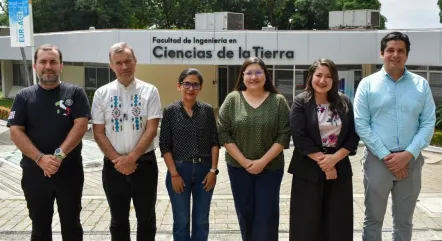 FICT-ESPOL will contribute isotope science to help understand and protect the groundwater on Santa Cruz Island in the Galápagos
A project led by researchers from FICT-ESPOL will provide scientific evidence to help understand the dynamics and vulnerability of groundwater in the Galápagos, strengthening its sustainable management and contributing to the protection of a vital resource for the island communities.
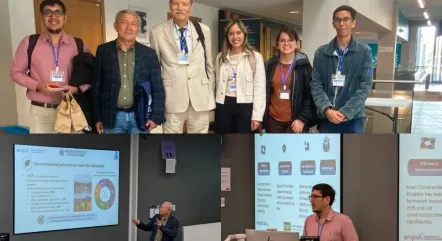 FICT and CIPAT are strengthening their international presence by presenting research projects at the Environmental Impact 2026 conference
FICT and CIPAT: ESPOL’s participation in an international conference in the United Kingdom strengthened the global reach of its research through the presentation of 12 studies on sustainable development, highlighting the collaborative work of its researchers and their scientific contributions to addressing environmental, productive, and social challenges.
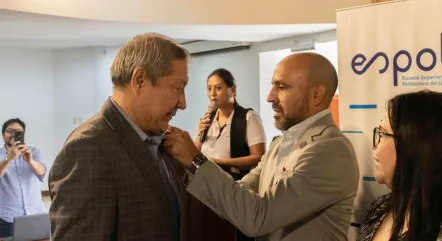 FICT Dean Earns iPEER International Certification, Strengthening Academic Leadership
Paúl Carrión, Ph.D., dean of FICT-ESPOL, has earned iPEER international certification, reaffirming the school’s commitment to academic excellence, faculty professional development, and the training of engineers in accordance with international educational quality standards.
 FICT promotes international dialogue on sustainable mining and industrial safety
FICT hosted the international seminar “Sustainable Mining and Industrial Safety,” featuring Ph.D. David León, a professor and researcher at the Polytechnic University of Madrid. The event provided an opportunity to share international perspectives on sustainability and safety in the mining industry, as well as to strengthen academic cooperation between ESPOL and the UPM within the framework of the Erasmus+ program.
 Experts from the UPM discuss sustainable solutions for the energy transition
FICT organized the conference “Sustainable Energy Solutions,” with the participation of faculty and researchers from the Polytechnic University of Madrid. The event addressed alternatives related to hydrogen-based energy storage, sustainable aviation fuels (SAF), and waste recovery, thereby strengthening international academic exchange between ESPOL and UPM.