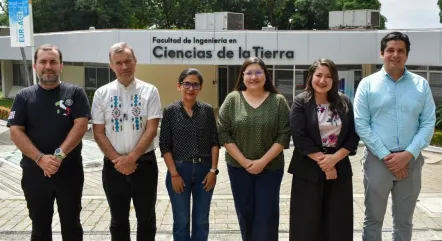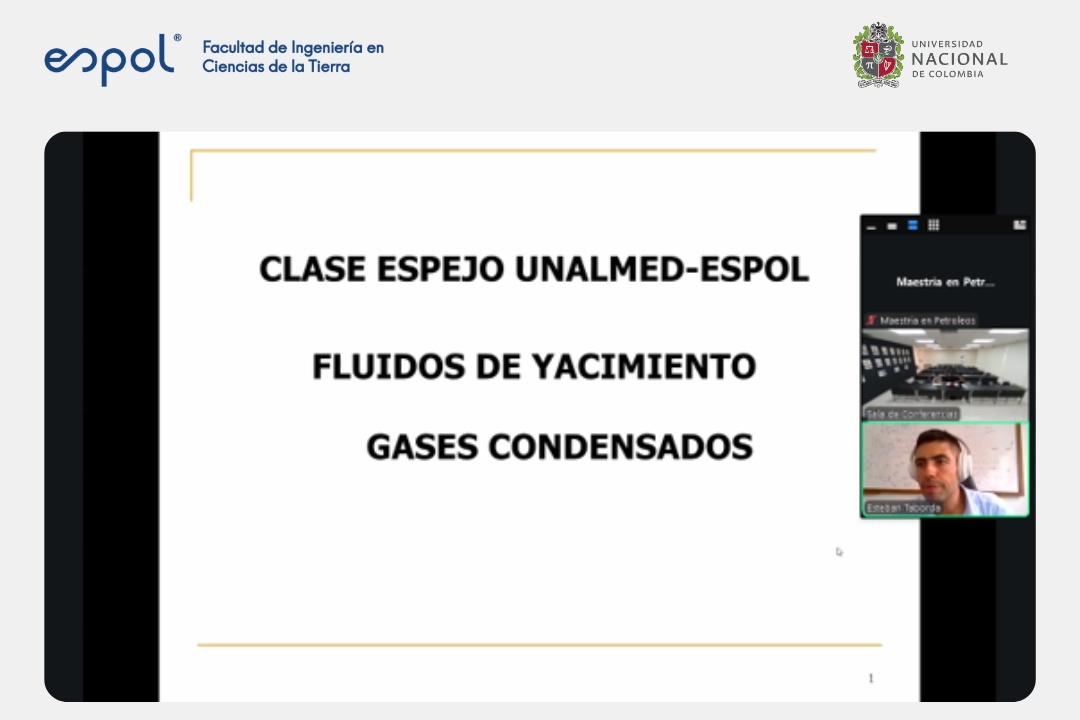


The Petroleum Engineering program at ESPOL’s Faculty of Geosciences Engineering (FICT) is strengthening its international academic cooperation ties by conducting two mirror classes for the course “Properties of Hydrocarbons and Phase Behavior,” held online during May and July 2026, in collaboration with the National University of Colombia (UNAL).
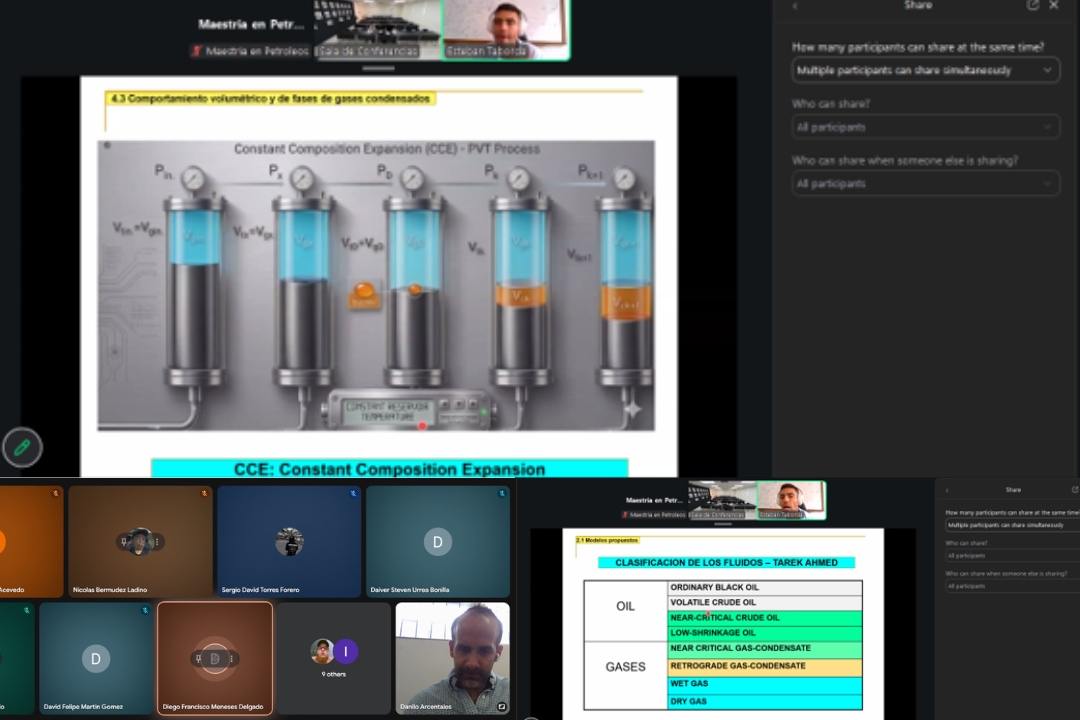
The first session took place on May 28 and was led by Esteban Taborda, Ph.D., a professor at the National University of Colombia (UNAL), who addressed the topic “Retrograde Gases.” Three students from ESPOL’s Petroleum Engineering program participated in this class.
The second class took place on July 22 and was taught by Danilo Arcentales, Ph.D., a professor at ESPOL, who presented on the topic “Fluid Sampling” to 20 students from UNAL’s Petroleum Engineering program. Each session lasted one hour.
These mirror classes allowed students and professors from both institutions to share the same academic space and explore specialized content from within their respective university communities. The initiative contributes to the internationalization of the Petroleum Engineering program through collaboration with higher education institutions in the region.
This experience also highlights FICT’s collaboration with external academic partners to expand learning opportunities for its students and strengthen the exchange of knowledge in areas related to the hydrocarbons industry.
Sustainable Development Goals (SDGs)
SDG 4: Quality Education. Strengthens learning through academic exchange with faculty and students from other institutions of higher education.
SDG 7: Affordable and Clean Energy. Relates to specialized training in areas linked to the hydrocarbons and energy sector.
SDG 9: Industry, Innovation, and Infrastructure. Promotes the updating of technical knowledge and academic collaboration in areas related to the energy industry.