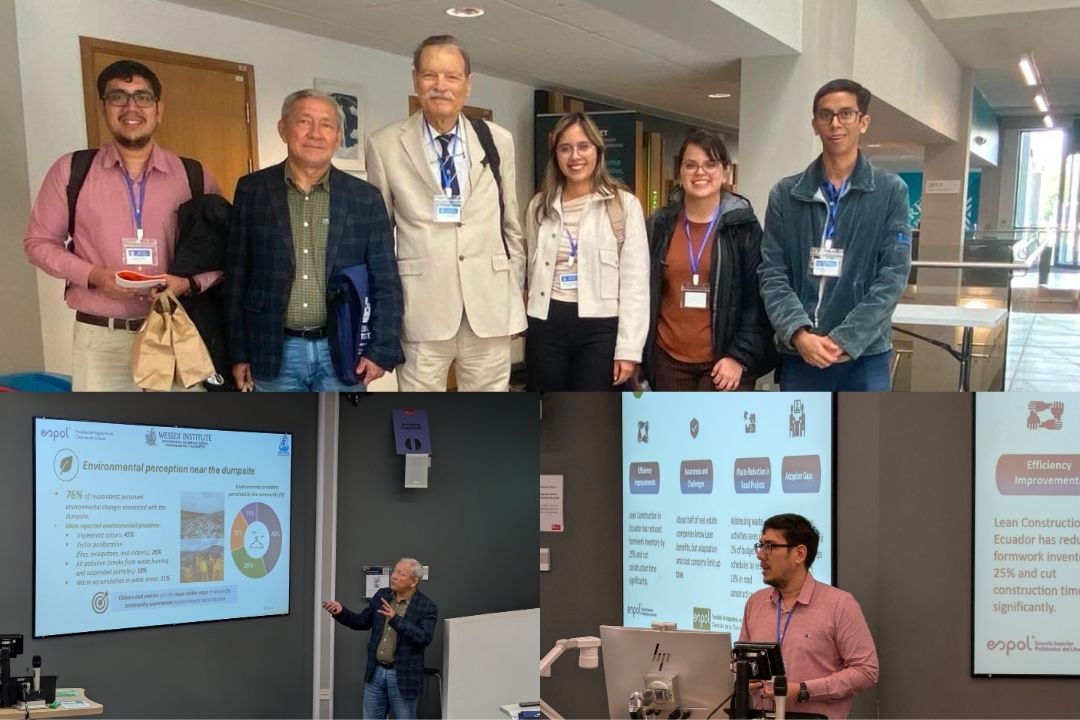


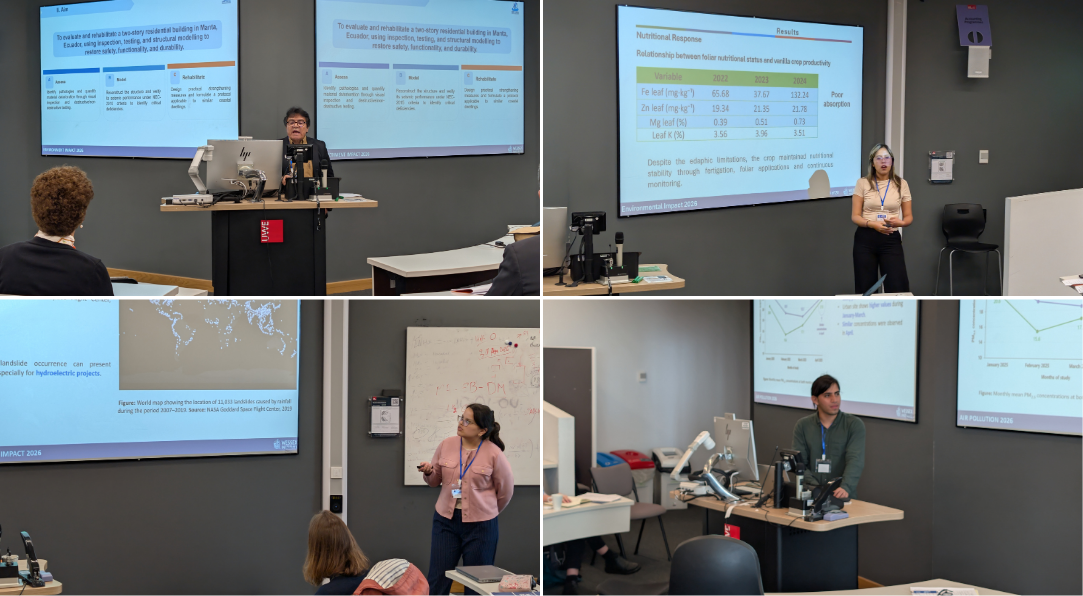
ESPOL’s Faculty of Geosciences Engineering (FICT) participated in the 6th International Conference on Environmental and Economic Impact on Sustainable Development (Environmental Impact 2026), held June 9–11, 2026, at the University of the West of England (UWE) in Bristol, United Kingdom. During this international conference, university representatives presented 12 scientific papers related to resilient infrastructure, water resources, geosciences, sustainable agriculture, environmental monitoring, and technologies applied to sustainable development.
The delegation consisted of researchers, faculty members, students, and technical staff from FICT and the Center for Research and Applied Projects in Geosciences (CIPAT). The delegation was led by Paúl Carrión Mero, dean of FICT, along with Fernando Morante Carballo, director of CIPAT; Josué Briones Bitar, coordinator of the Master’s Program in Earth Sciences; María Jaya Montalvo and Lady Bravo Montero, research technicians at CIPAT; Jairo Dueñas Tovar, a research technician at the center; and Alfonso Lombeida Román, a student at FIMCP, who represented ESPOL in the presentation of the scientific papers.
The 12 scientific papers presented addressed various topics related to sustainable development, including the application of the Lean Construction philosophy to project supervision, the rehabilitation of infrastructure and built heritage, water resource management, environmental monitoring using remote sensing tools, groundwater exploration, food traceability using blockchain technology, corrosion analysis in the oil industry, waste management, and the optimization of water use in agricultural production. Taken together, these studies reflect the multidisciplinary nature of the research conducted at ESPOL and its contribution to finding solutions to environmental, productive, and social challenges.
ESPOL’s participation in this international conference enhanced the visibility of the university’s research and provided an opportunity to share scientific advances on a global stage. The presentation of these 12 studies highlights the coordinated efforts among faculties, research centers, faculty members, researchers, students, and technical staff, as well as the institution’s commitment to generating knowledge that contributes to the sustainable management of natural resources, the development of resilient infrastructure, and the search for solutions to environmental and productive challenges. In this way, ESPOL continues to build on its contributions to science and strengthen its presence in international research and academic cooperation networks.
Sustainable Development Goals
SDG 6: Clean Water and Sanitation. Research includes solutions for water resource management, access to water, watershed monitoring, and the sustainable use of water resources.
SDG 9: Industry, Innovation, and Infrastructure. Studies promote the development of resilient infrastructure, technological innovation, and applied research for various productive sectors.
SDG 11: Sustainable cities and communities. Research related to infrastructure, built heritage, environmental management, and risk prevention contributes to the sustainable development of regions.