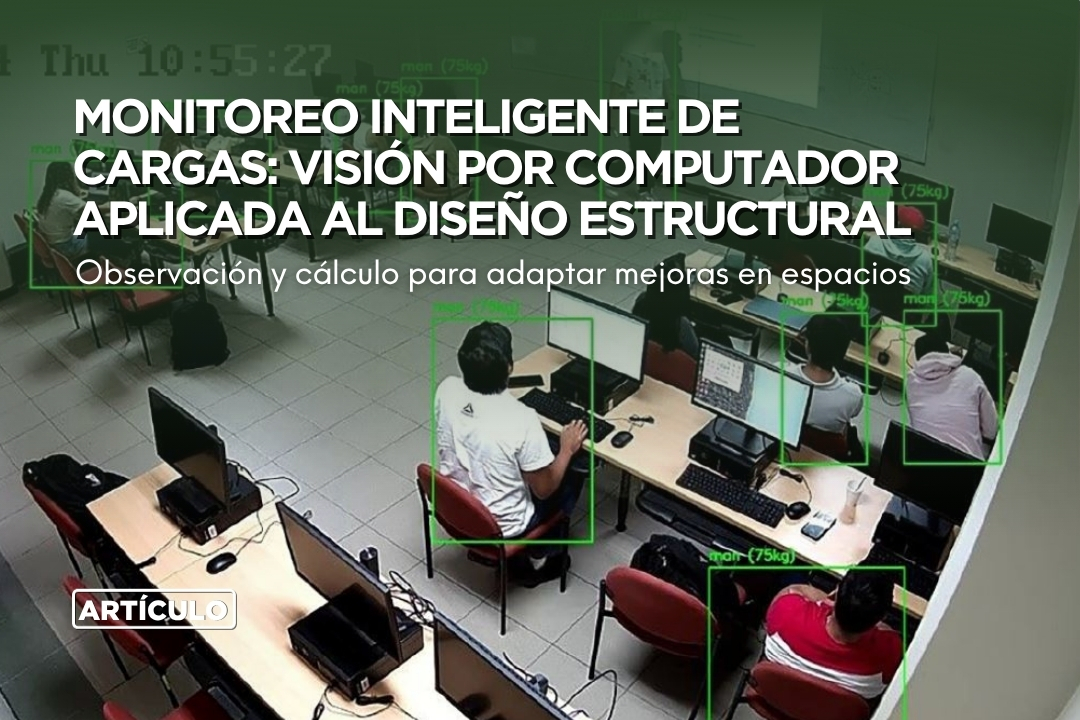


A group of professors from the Faculty of Geosciences Engineering (FICT) at the Escuela Superior Politécnica del Litoral (ESPOL) is leading a research project that proposes a new method for assessing actual loads on buildings using surveillance cameras and artificial intelligence. This approach allows for real-time measurement of the number of people and estimation of their impact on the structure, replacing the traditional values established by design codes, which are typically estimates.
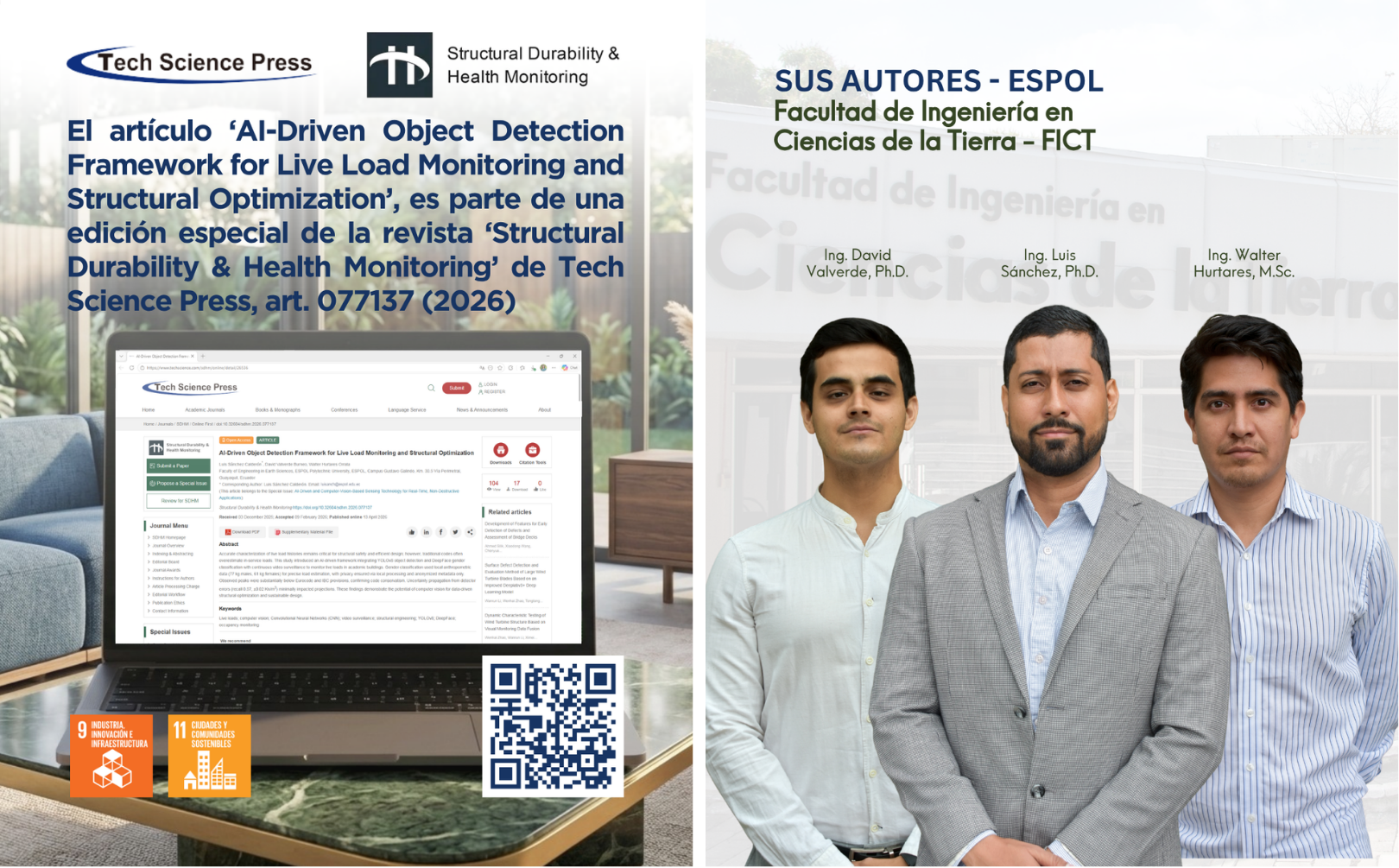
The study, titled “AI-Driven Object Detection Framework for Live Load Monitoring and Structural Optimization,” was published in the journal Structural Durability & Health Monitoring by Tech Science Press, as part of the special issue “AI-Driven and Computer-Vision-Based Sensing Technology for Real-Time, Non-Destructive Applications.”
Authors:
Ing. Luis Sánchez, Ph.D.
Ing. Walter Hurtares, M.Sc.
Ing. David Valverde, Ph.D.
The researchers implemented a system that combines algorithms such as YOLOv8, for detecting people, and DeepFace, for estimating characteristics that allow for an approximation of their weight. The pilot was conducted in Building 13H at FICT, monitoring hallways, stairwells, and a computer lab.
The results of the pilot study show that actual loads are significantly lower than those estimated by design codes. This finding opens up opportunities to optimize material use and reduce costs without compromising structural safety, representing a significant contribution to the construction sector. Many more years of research are still needed to change the codes, but this is the direction this study proposes. Furthermore, the use of real-time data strengthens engineering decision-making, contributing to the development of more efficient infrastructure.
This initiative aligns with ESPOL’s mission to promote applied research that impacts society and the productive sector. It also lays the groundwork for future applications in smart buildings, where continuous monitoring can improve both the design and operation of infrastructure, benefiting students, faculty, and professionals in the field.
DOI: 10.32604/sdhm.2026.077137
Alignment with the Sustainable Development Goals (SDGs)
SDG 9: Industry, Innovation, and Infrastructure, by promoting the use of advanced technologies to improve structural design.
SDG 11: Sustainable Cities and Communities, by contributing to the development of more efficient, safe, and sustainable buildings through the use of real-world engineering data.