

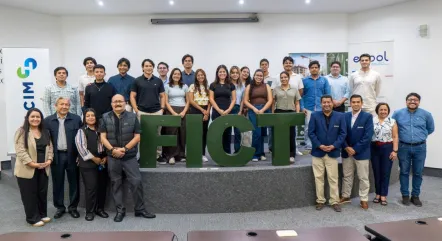
 Holcim Academy launched its eighth cohort with a module on sustainability
FICT ESPOL launched the eighth cohort of the Holcim Academy, an initiative developed in partnership with the industry to strengthen the training of future civil engineers in sustainability and responsible construction; the first module focused on the circular economy and waste management, promoting skills geared toward innovation and sustainable development in the construction sector.
 The SPE–ESPOL Student Chapter Conducts an International Technical Visit to YPF’s La Plata Industrial Complex
Students from the SPE–ESPOL Student Chapter took an international technical field trip to YPF’s La Plata Industrial Complex in Argentina, where they learned about the refining and operational processes at one of South America’s most important energy complexes; the experience strengthened their practical training and exposed these future engineers to high-tech industrial environments.
 Sustainable Innovation in Concrete Technology
Faculty members and researchers from the FICT and the Master’s Program in Seismic-Resistant Civil Structures continue to enhance ESPOL’s international profile through scientific publications in specialized journals such as CPI Worldwide. Their research promotes sustainable and innovative solutions for civil engineering, incorporating recycled materials and eco-efficient technologies.
 The SPE–ESPOL Student Chapter represented Ecuador at the 2026 LACSS Regional PetroBowl
The ESPOL SPE Student Chapter represented Ecuador at the PetroBowl Regional LACSS 2026 international competition in Argentina, where petroleum engineering students demonstrated their technical knowledge and analytical skills against teams from across Latin America; the experience strengthened their professional training and reaffirmed the international presence of FICT and ESPOL in the energy sector.
 Machine Learning Models for CO₂ WAG and SAG in an Open-Source Environment Open-Source Predictive Models for Optimizing CO₂-EOR
The study develops predictive models based on machine learning to optimize the evaluation of CO₂ injection in enhanced oil recovery (EOR), reducing the need for multiple complex numerical simulations. Using open-source tools, the models achieve high accuracy in predicting production and CO₂ retention, positioning them as an efficient and reproducible alternative for decision-making in reservoir engineering.
 International Model Class Enhanced Knowledge of Wastewater Treatment Using Wetlands
ESPOL and the University of Commercial Sciences of Nicaragua held an international mirror class on wastewater treatment using wetlands, strengthening academic cooperation and the exchange of knowledge in environmental sanitation; the activity allowed undergraduate and graduate students to analyze sustainable solutions and simulation tools applied to water resource management.
 FICT Launches the Third Cohort of the Master's Program in Earth Sciences
FICT kicked off the third cohort of the Master’s in Earth Sciences with a welcome session during which 14 students were introduced to the academic structure, the faculty, the research areas, and the infrastructure available to support their studies. The program strengthens specialized training in geosciences and prepares professionals to address challenges related to sustainability, environmental management, and natural resource management.
 FICT Launches Platform for Tracking International Academic Mobility
FICT held a workshop on the use of the international academic mobility registration platform, aimed at optimizing the management of these processes. The event made it possible to establish guidelines and agreements that strengthen internationalization and the efficient use of digital tools.
 FICT Research Applies InSAR Technology for Volcanic Monitoring in Ecuador
ESPOL's FICT participated in a study published in a Q1 journal that uses InSAR technology and Sentinel-1 data to analyze the deformation of volcanoes in northern Ecuador. The results demonstrate the potential of these techniques to strengthen volcanic monitoring and risk management through non-invasive tools.
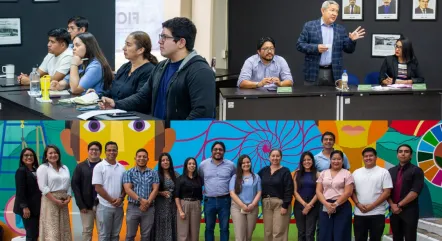 FICT Welcomes Non-Tenured Adjunct Faculty for the 2026 IPAO Term
FICT welcomed the non-tenured adjunct faculty members joining the faculty during the 2026 IPAO period at an orientation session designed to facilitate their academic and administrative integration. During the session, institutional processes, support tools, and work guidelines were presented, strengthening the bond between the new faculty members and the faculty’s academic community.