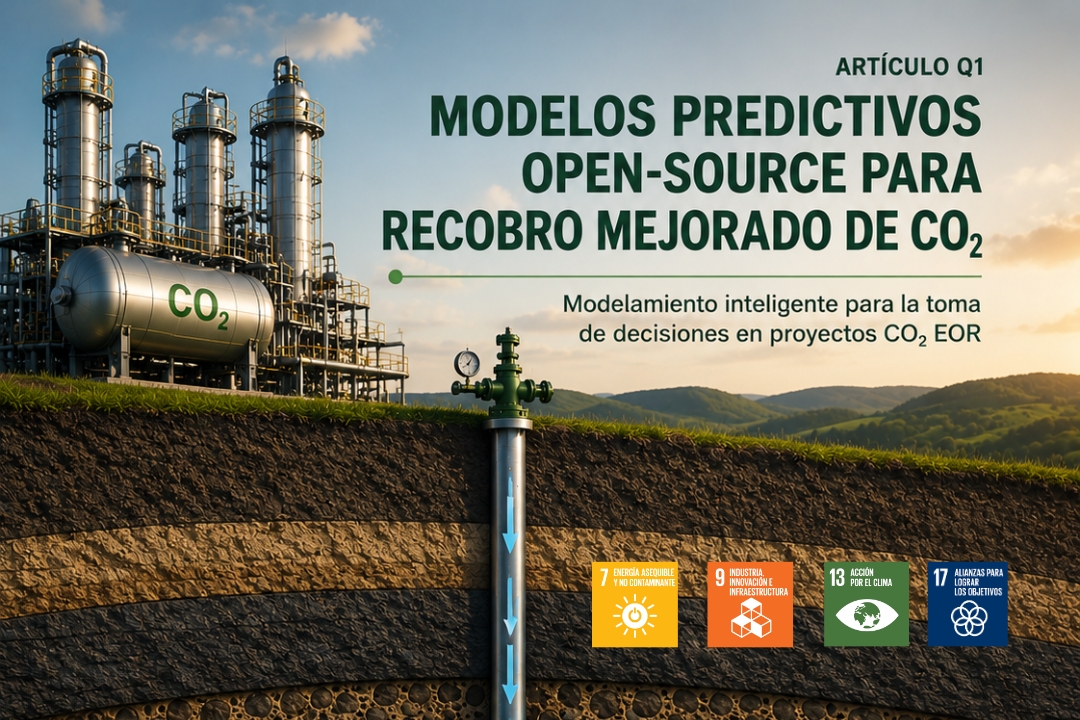


The pre-implementation evaluation of CO₂ injection in enhanced oil recovery (CO₂-EOR) and geological storage processes requires running hundreds or thousands of numerical simulations to compare injection strategies such as WAG (Water Alternating Gas) and SAG (Surfactant Alternating Gas). However, these simulations are computationally expensive and often rely on commercial software, which limits their scientific reproducibility; to address this, predictive models—known as proxy models—can be developed.
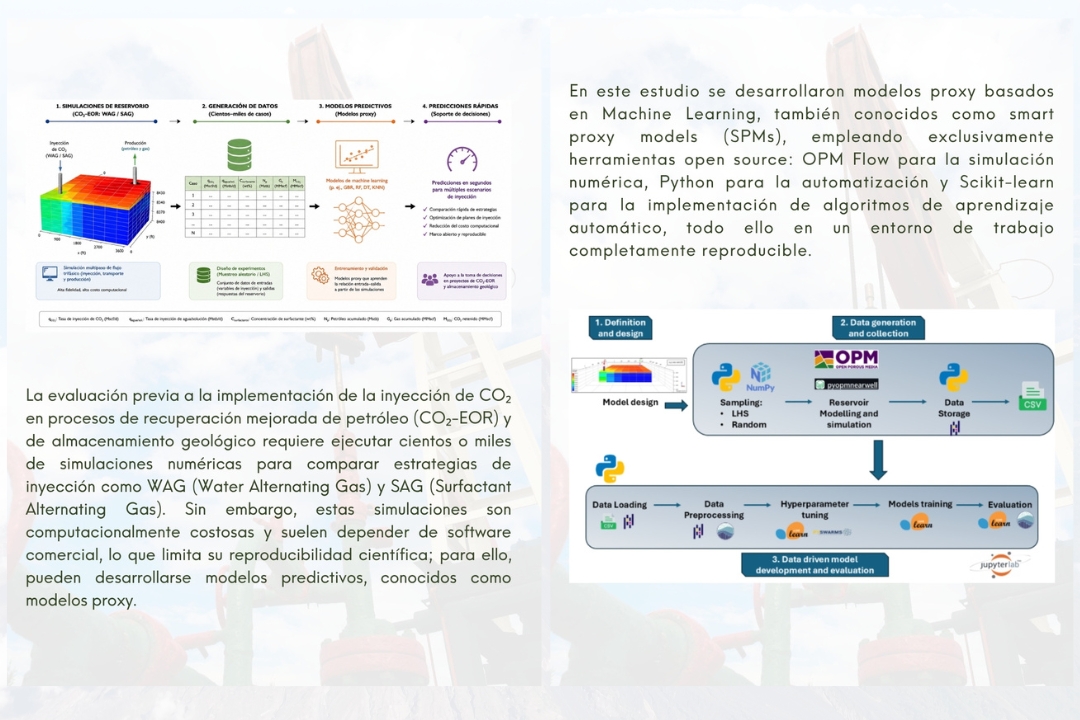
In this study, machine learning-based proxy models—also known as smart proxy models (SPMs)—were developed using exclusively open-source tools: OPM Flow for numerical simulation, Python for automation, and Scikit-learn for implementing machine learning algorithms, all within a fully reproducible workflow.
The SPMs developed in this study are capable of predicting cumulative oil and gas production and CO₂ retention in WAG and SAG models, using datasets of 100 and 300 simulations (SPE CSP-5) and algorithms such as K-nearest neighbors, decision trees, random forest, and gradient boosting regressor (GBR). With 300 simulations, the GBR achieved high accuracy (R² > 0.995 for CO₂ sequestration, ≈ 0.999 for oil produced, and > 0.990 for gas produced), with an RMSE of less than 1%, demonstrating its potential as an efficient tool for prediction and decision-making in reservoir engineering that is accessible to all.
Participating researchers
FICT – ESPOL
Jorge Rodrigo Lliguizaca-Davila
Freddy Carrión Maldonado
Jorge Segundo Mendoza Sanz
Collaboration
University of Bergen (UiB), Norway
David Landa Marbán
Jorge Rodrigo Lliguizaca-Davila
Hilde Halsøy
Jacquelin E. Cobos
Zachary Paul Alcorn
DOI: https://doi.org/10.1016/j.petlm.2026.02.003
Sustainable Development Goals
SDG 7: Affordable and Clean Energy
SDG 9: Industry, Innovation, and Infrastructure
SDG 17: Partnerships for the Goals