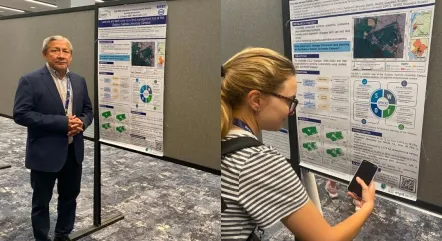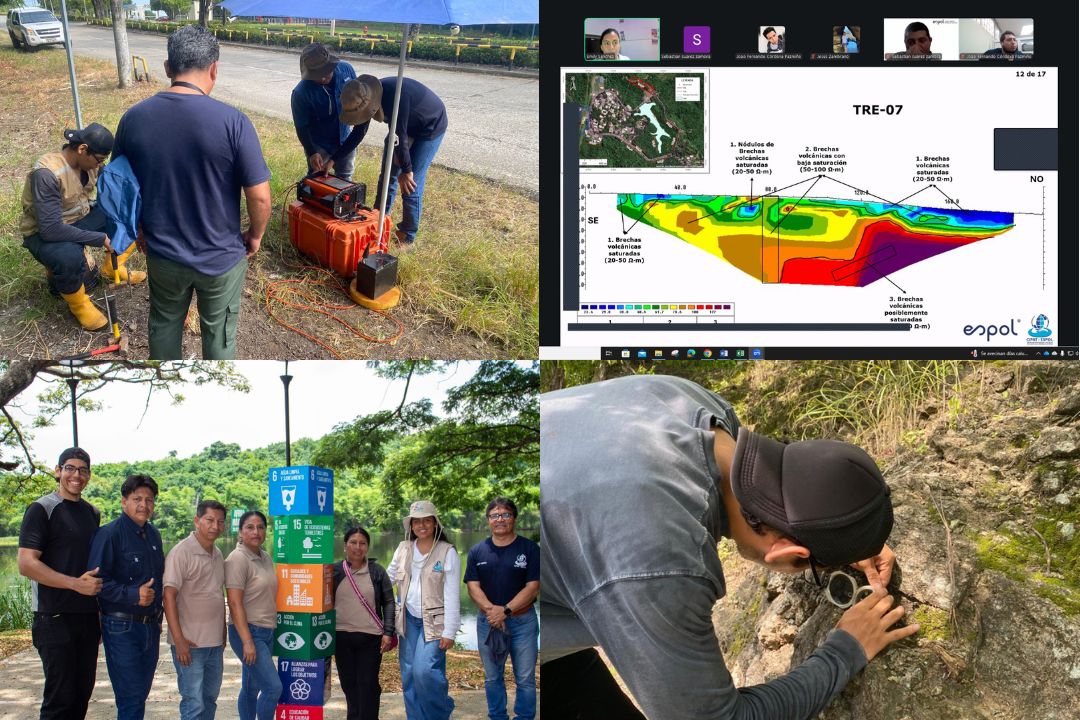

The Escuela Superior Politécnica del Litoral (ESPOL) is advancing its commitment to sustainability and integrated water resource management through the project “ESPOL Ecohydrology Demonstration Site: Lakes and Albarradas,” an initiative aimed at obtaining official recognition as an Ecohydrology Demonstration Site from UNESCO.
This project highlights the natural infrastructure of the Gustavo Galindo Velasco campus and showcases sustainable water management as a cross-cutting theme in land-use planning, ecosystem conservation, and academic education. Through the existing lakes and earthen dams on campus, ESPOL demonstrates the principles of ecohydrology in practice, integrating the dual regulation of water and biota as the foundation for sustainable solutions:
Ponds and earthen dams: traditional techniques in the service of sustainability
Lakes and earthen dams serve as water harvesting and storage techniques, considered Nature-Based Solutions (NBS). These structures allow water to be stored during the rainy season and released gradually, generating multiple environmental, social, and economic benefits.
Among the project’s main contributions are:
• Flood mitigation in populated areas surrounding the campus by regulating surface runoff during heavy rainfall events.
• Support for fire control by serving as strategic water reserves in an environment vulnerable to drought.
• Ecosystem conservation, given that the ESPOL campus is located within the Prosperina Protected Forest and Vegetation Area, one of the region’s most important remaining patches of tropical dry forest.
• A living learning laboratory that strengthens teaching, research, and community engagement, enabling practical training for students, faculty, and researchers.
A campus that learns from the land
The “Ecohydrology Demonstration Site” project is conceived as a space for continuous learning, where the territory becomes an open classroom. From the observation of ecohydrological processes to the analysis of green and blue infrastructure, it fosters the generation of applied knowledge and interdisciplinary innovation.
The initiative is coordinated by Maribel Aguilar Aguilar, Ph.D. (c), a professor in the Faculty of Earth Sciences Engineering (FICT) and a researcher at the Center for Research and Applied Projects in Earth Sciences (CIPAT), with the support of Paúl Carrión, Ph.D., dean of FICT, and Fernando Morante, Ph.D., director of CIPAT.
Collaborative Work and Institutional Impact
The project is being carried out collaboratively, bringing together more than 10 academic units and institutional centers at ESPOL, including the UNESCO Chair in Geosciences Applied to Sustainable Development. It is also guided by Marco Albarracín Rodas, M.Sc. (Coordinator of the Network of Ecohydrology Demonstration Sites in Latin America and the Caribbean and member of the Scientific Advisory Committee on Ecohydrology (SAC) of UNESCO-PHI), as well as the strategic partnership with the SbN-GIA Network—Nature-Based Solutions for Integrated Water Management in Vulnerable Communities.
Through the “Ecohydrology Demonstration Site: ESPOL Lakes and Albarradas” project, the university reaffirms its commitment to a sustainable, resilient campus model aligned with the environmental challenges of the 21st century, where engineering, nature, and knowledge converge to generate a positive impact on society.
Sustainable Development Goals
SDG 4: Quality Education
SDG 6: Clean Water and Sanitation
SDG 15: Life on Land