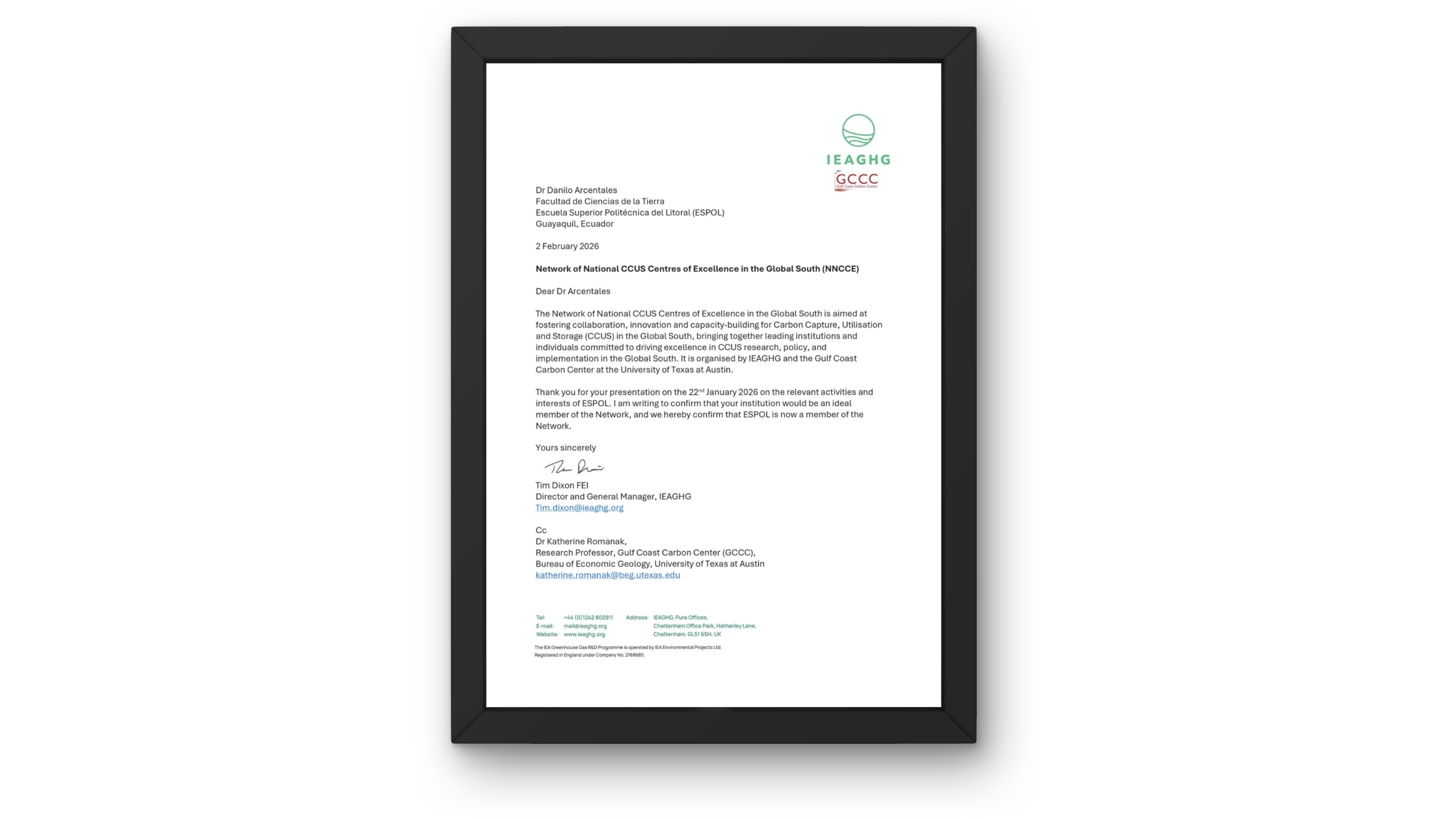



The Escuela Superior Politécnica del Litoral (ESPOL) has officially joined the Network of National CCUS Centers of Excellence in the Global South (NNCCE), an international initiative aimed at strengthening collaboration, innovation, and the development of academic, technical, and research capabilities in Carbon Capture, Utilization, and Storage (CCUS) technologies.
The effort to make ESPOL part of this network was led by the Faculty of Geosciences Engineering (FICT), which coordinated the institutional presentation of the university's scientific and technical capabilities in the field of CCUS, consolidating its position in key technologies for climate change mitigation and energy transition.
The network is organized by IEAGHG and the Gulf Coast Carbon Center at the University of Texas at Austin and brings together leading institutions from the Global South committed to excellence in research, public policy, and implementation of CCUS solutions.
The meeting was attended by Tim Dixon, M.Sc., Director and General Manager of IEAGHG, and Katherine Romanak, Ph.D., Research Professor at the Gulf Coast Carbon Center. Representing ESPOL were professors Ph.D. Danilo Arcentales, Ph.D. José Cóndor, Ph.D. Priscila Valverde, Ph.D. (c) Jorge Lliguizaca, M.Sc. Freddy Carrión, and M.Sc. Cecibel Castillo, who presented the lines of research and institutional capabilities in this strategic area.
Strategic projection and international cooperation
The aim of joining this network is to strengthen ESPOL's regional position in CCUS technology, promoting international collaboration, knowledge exchange, and the development of strategic projects with an impact on sustainability and energy.
With this incorporation, ESPOL expands its opportunities for scientific and technical cooperation, strengthening its contribution to the global challenges of decarbonization.
Alignment with the Sustainable Development Goals
This initiative aligns with the following Sustainable Development Goals (SDGs):
SDGs 7: Affordable and clean energy
SDGs 9: Industry, innovation and infrastructure
SDGs 13: Climate action
SDGs 17: Partnerships for the goals
ESPOL thus reaffirms its commitment to international cooperation and the development of high-impact scientific solutions to tackle climate change.