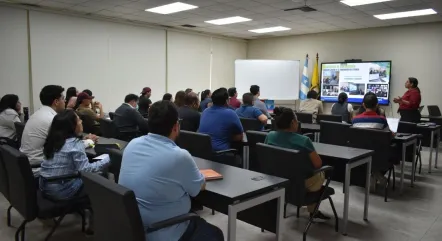


As part of its commitment to training highly skilled professionals who are in step with current technological trends, ESPOL’s Master’s Program in Civil Engineering with a concentration in Construction and Sanitation organized a seminar titled “AI in Project Management: Tools, Use Cases, and Challenges in Engineering and Construction Projects.”
This academic event aimed to analyze the impact of artificial intelligence on the planning, execution, and control of projects within the engineering and construction sector, highlighting its role in process optimization, information management, and data-driven decision-making.
The talk was delivered by Carlos Pampliega, M.Sc., who presented a comprehensive overview of the evolution of artificial intelligence in the field of project management, a topic that currently occupies a central place in international forums such as those promoted by the International Project Management Association.
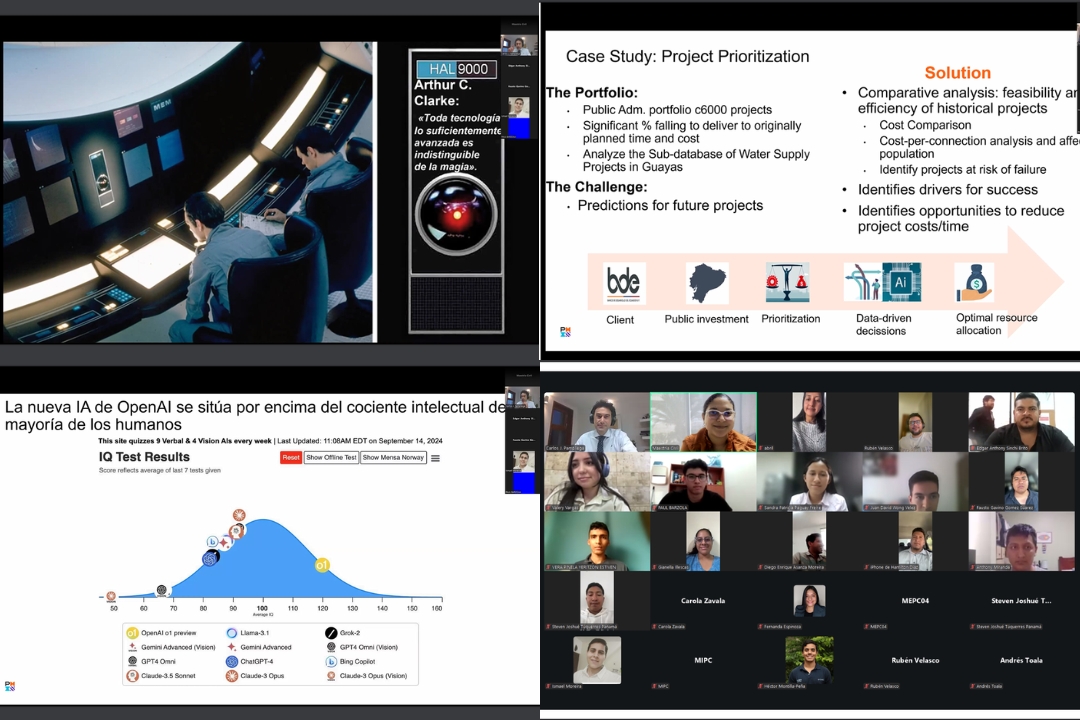
During his presentation, he addressed three key levels of artificial intelligence application in projects. First, process automation, focused on operational tasks such as report generation, meeting transcription, and the systematization of lessons learned. Second, the use of AI as an assistant in more complex activities, such as risk analysis, cost-benefit assessment, planning, and schedule estimation. Finally, its role as a capacity-building tool was highlighted, enabling professionals to make more informed decisions, enhance their creativity, and improve strategic project analysis.
Likewise, case studies were presented in which artificial intelligence enables the use of historical data to generate more accurate estimates, define project scope through language models, and analyze qualitative aspects such as communication and stakeholder expectations, even incorporating tone and sentiment analysis within work teams.
Another key point was the discussion of the impact of these technologies on professional practice. Far from replacing the project manager, artificial intelligence redefines their role, shifting it toward more strategic and higher-value-added functions, while automating repetitive and less complex tasks.
Similarly, the challenges associated with its implementation were discussed, including the need to adapt to change, the development of new digital skills, and an understanding of the ethical and social risks linked to the use of these technologies.
Participants had the opportunity to reflect on the potential of artificial intelligence to transform the construction industry by promoting more innovative, sustainable, and efficient practices, as well as on the role of professionals as “explorers” in a constantly evolving technological environment.
Through initiatives like this, the Master’s in Civil Engineering with a concentration in Construction and Sanitation strengthens its students’ academic training, fostering the development of key competencies to address the challenges of an increasingly digitized professional environment.
Sustainable Development Goals
SDG 4: Quality Education
SDG 9: Industry, Innovation, and Infrastructure