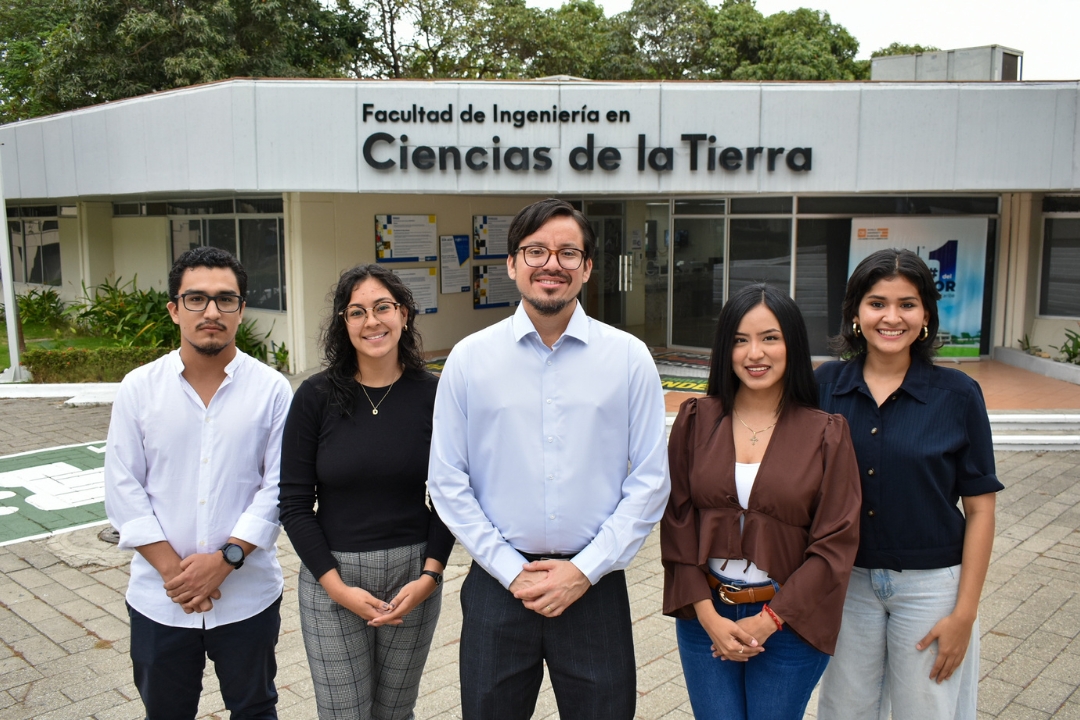


The project is led by Andrés Danilo Velástegui Montoya, Ph.D., and co-led by Isabel Adriana Chuizaca Espinoza, M.Sc., both researchers at ESPOL’s Geoinformation and Remote Sensing Laboratory. The team also includes Samuel Enrique Mora Mejía, a researcher at the laboratory, as well as Daniela Cristina Romero Bermeo and María Valentina Ramírez San Miguel, students in the Faculty of Life Sciences and members of the GIS and Remote Sensing Research Group, who have contributed to the development of research and scientific publications on illegal mining and its impacts on the Amazon.
The call for proposals, funded by the European Union and implemented by COOPI – Cooperazione Internazionale, in partnership with the University of San Francisco de Quito (USFQ) and the National Open and Distance Learning University (UNAD), seeks to strengthen scientific research aimed at addressing deforestation, environmental degradation, and forest fires in the Amazon basin. The selection of this project recognizes the scientific track record of the Geoinformation and Remote Sensing Laboratory and the work of ESPOL’s GIS and Remote Sensing Research Group in the use of geographic information systems, remote sensing, multi-criteria spatial analysis, and geospatial intelligence.
In recent years, the team has conducted research on the Ecuadorian and Brazilian Amazon using methodologies to analyze mining pressure, assess environmental vulnerability, and monitor land-use changes. These findings have been published in international scientific journals and presented at specialized conferences such as IGARSS, ISPRS, and SBSR, strengthening ESPOL’s scientific capabilities and positioning FICT as a leader in applied geospatial research.
The funding obtained will be used to develop spatial tools to identify and zone priority areas where illegal mining and forest degradation pose the greatest risks to ecosystems in the southern Ecuadorian Amazon. Key project outputs include high-resolution thematic maps, an interactive StoryMap for disseminating results, and participatory workshops with Decentralized Autonomous Governments (GADs), local communities, and civil society organizations, promoting evidence-based decision-making for biodiversity conservation and sustainable land management.
This achievement reflects FICT’s commitment to generating high-impact scientific knowledge and coordinating efforts with international organizations, academic institutions, and local stakeholders. It also strengthens the training of new researchers and reaffirms ESPOL’s role as a leader in applied research aimed at addressing the environmental challenges of the Amazon region.