
The Escuela Superior Politécnica del Litoral (ESPOL) participated in an international initiative of the International Atomic Energy Agency (IAEA) aimed at better understanding the origin of nitrate pollution in surface and groundwater systems through the integration of isotopic tools and the study of emerging contaminants.
The research was part of the IAEA Coordinated Research Project “Improving the Understanding of Nitrate Sources in Connected River and Groundwater Systems through the Integration of Nitrate Isotopes and Emerging Contaminants,” carried out between 2022 and 2026. The initiative brought together studies conducted in different regions of the world; in Latin America, Ecuador and Argentina were the only participating countries, highlighting the region’s presence within this international scientific collaboration. Within this framework, ESPOL carried out the project in Ecuador titled “Hydrochemical and Isotopic Assessment of Nitrate and Emerging Contaminant Pollution in the Waters of a Vulnerable Semi-Arid Area Affected by the Expansion of Agriculture and Tourism: Santa Elena Peninsula, Ecuador.”
The project was led by Johanna Zambrano Anchundia, M.Sc., a professor in the Petroleum Engineering program, and involved Priscila Valverde Armas, Ph.D.; Tomas Vitvar, Ph.D.; and Cindy Goyburo Chávez, M.Sc., researchers at FICT. On behalf of the IAEA, the project was coordinated and scientifically supported by Yuliya Vystavna, Ph.D., a specialist with the international agency’s Division of Physical and Chemical Sciences. The study was conducted primarily in Chanduy, Santa Elena Province, a semi-arid area where agricultural, tourism, aquaculture, and domestic activities—all closely linked to water use—coexist. These conditions, combined with the challenges of water availability and salinity facing the peninsula, make the region a key setting for studying how different human activities can influence the quality of its water resources.
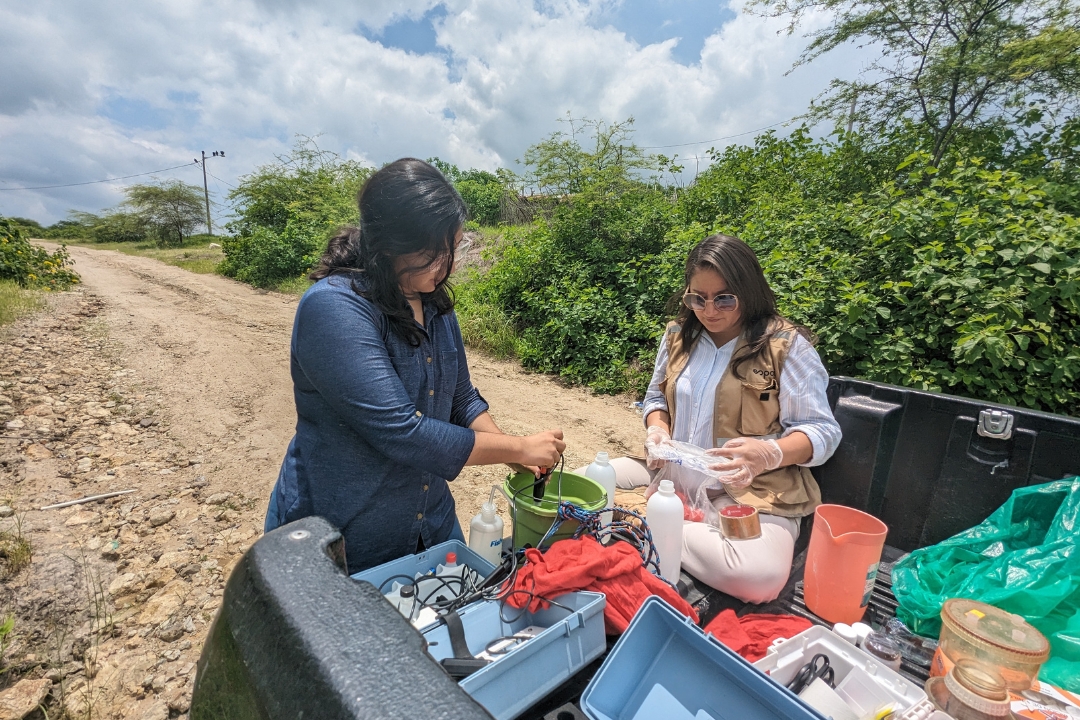
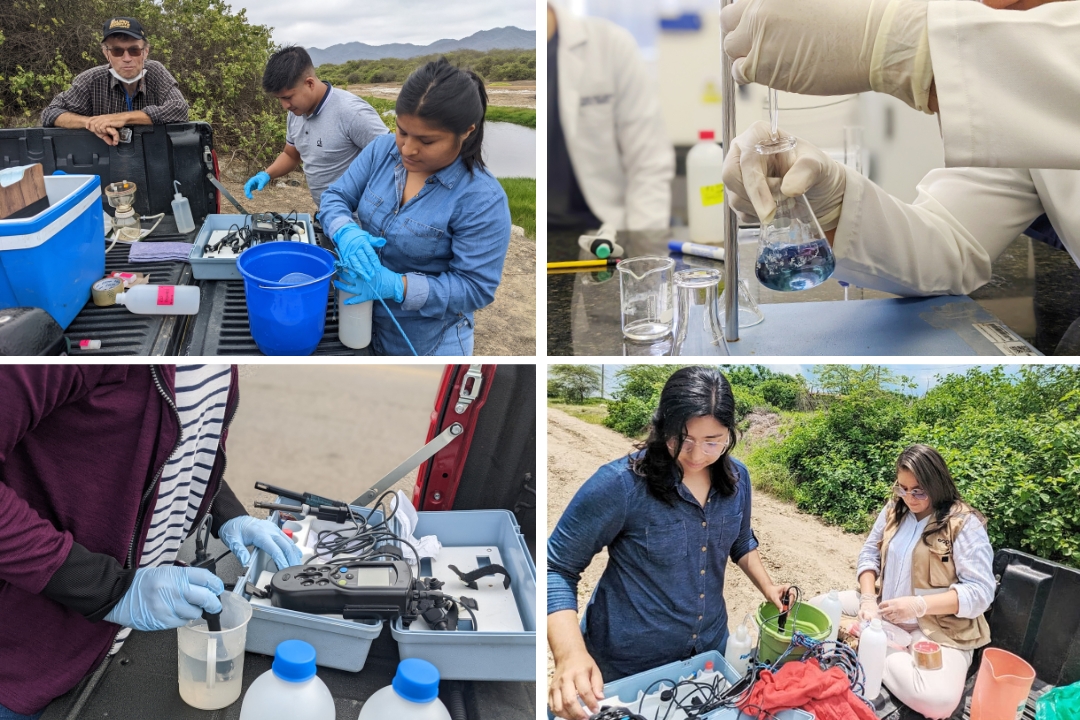
Between 2022 and 2025, six sampling campaigns were conducted, covering both dry and rainy seasons. During these campaigns, samples were collected for physicochemical, hydrochemical, isotopic, and emerging contaminant analyses, which made it possible to observe variations in the system under different environmental conditions. One of the main contributions of the research was combining the information provided by nitrate isotopes—especially nitrogen-15 (δ¹⁵N-NO₃)—with the analysis of emerging contaminants. Isotopes act as a kind of “fingerprint” that helps track nitrate present in the water, while emerging contaminants provide additional information to distinguish between possible sources associated with agricultural, domestic, or other land-use activities.
These types of contaminants also pose a growing challenge for environmental management, as many can be found in water at very low concentrations, and significant gaps in information and regulation still exist. In the case of Ecuador, the IAEA report notes that national regulations do not establish limit values for most of these compounds.
La problemática también fue abordada por el equipo en el artículo científico “Emerging Contaminants in Natural Freshwaters of the Pacific Coast of South America: State of the Art and Recent Developments”, desarrollado en el marco del proyecto y enfocado en analizar el estado del conocimiento sobre estos contaminantes en aguas dulces de la costa del Pacífico sudamericano.Algunos de los resultados obtenidos en Ecuador forman parte del IAEA-TECDOC-2126, “Improving the Understanding of Nitrate Sources in Freshwater Systems Through Linking Isotopes and Contaminants of Emerging Concern”, publicado por el OIEA en 2026. Esta publicación reúne los principales avances y experiencias generados dentro del proyecto coordinado y posiciona el caso ecuatoriano dentro de una discusión internacional sobre nuevas herramientas para comprender la contaminación del agua.
The team also addressed this issue in the scientific article “Emerging Contaminants in Natural Freshwaters of the Pacific Coast of South America: State of the Art and Recent Developments,” which was developed as part of the project and focused on analyzing the current state of knowledge regarding these contaminants in freshwater systems along the South American Pacific coast. Some of the results obtained in Ecuador are included in IAEA-TECDOC-2126, “Improving the Understanding of Nitrate Sources in Freshwater Systems Through Linking Isotopes and Contaminants of Emerging Concern,” published by the IAEA in 2026. This publication compiles the main advances and experiences generated within the coordinated project and positions the Ecuadorian case within an international discussion on new tools for understanding water pollution.
ESPOL’s participation in this initiative strengthens the presence of Ecuadorian research in international scientific cooperation forums and contributes knowledge toward a better understanding of the factors that affect water quality. From Santa Elena, the project demonstrates how scientific research can help generate evidence for more informed and sustainable water resource management.
Sustainable Development Goals (SDGs)
SDG 6: Clean Water and Sanitation
SDG 9: Industry, Innovation, and Infrastructure
SDG 11: Sustainable Cities and Communities