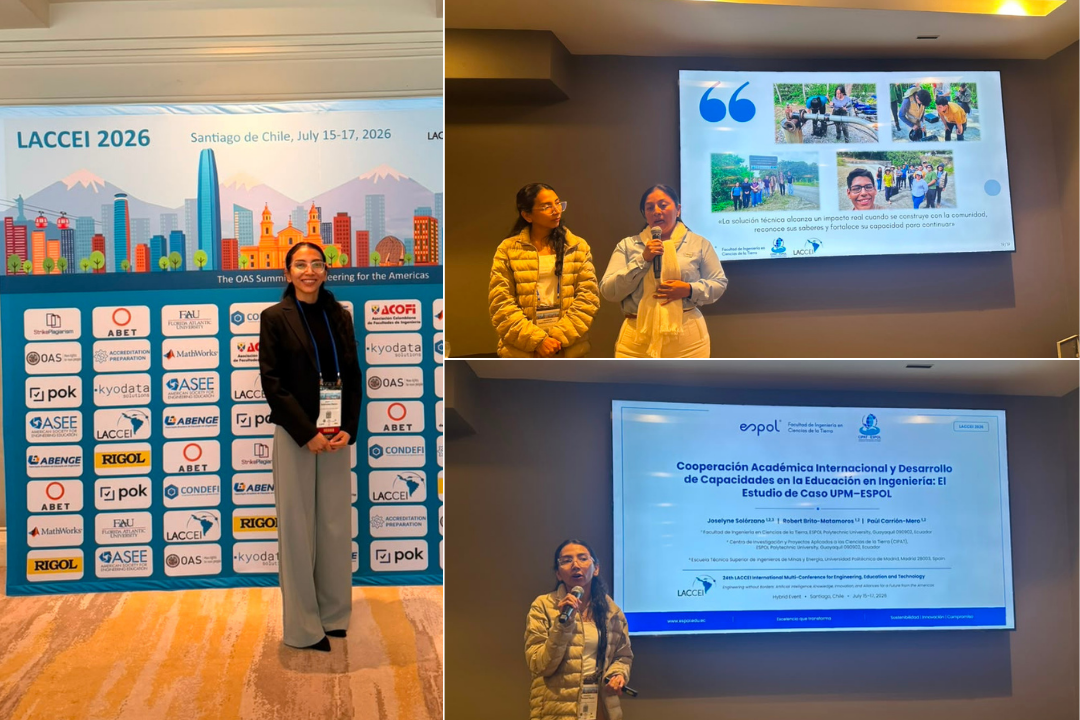
ESPOL’s Faculty of Geosciences Engineering (FICT) participated in the 24th LACCEI International Multi-Conference for Engineering, Education, and Technology, held July 15–17 in Santiago, Chile, where it presented research related to humanitarian engineering, engineering education, and integrated water management in vulnerable communities.
During this international gathering, scientific articles indexed in Scopus were presented, and opportunities for academic exchange and collaboration with researchers and representatives from institutions in other countries were fostered.
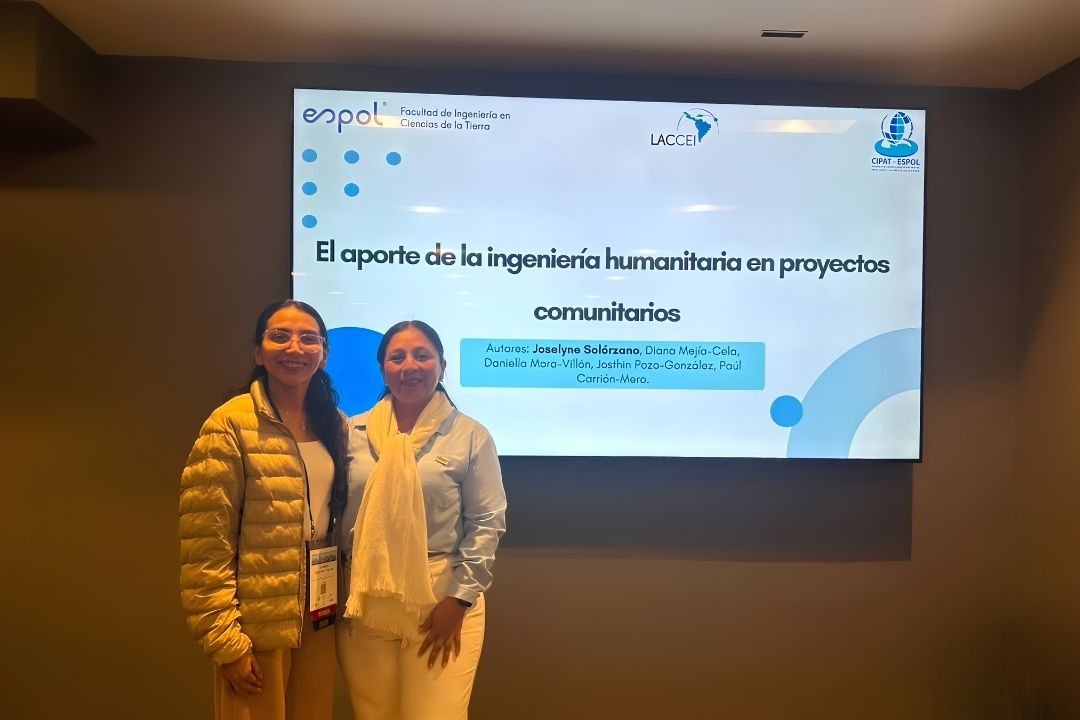
One of the papers presented was “The contribution of humanitarian engineering to outreach projects,” a study that compiles experiences from community engagement projects led by FICT faculty members, in which collaboration between academia and communities is a fundamental element in addressing challenges related to the local area and its resources. The article also features geology student Josthin Pozo as a co-author, highlighting the involvement of students in research processes and the generation of knowledge that impacts communities.
As part of this presentation, Joselyne Solórzano, Ph.D. (c), along with Gloria Malavé, president of the Manglaralto Water Board and representative of the municipality, served as speakers to share their experience of collaboration between academia and the community. This collaboration has been ongoing for more than 20 years, focusing on sustainable water management and the strengthening of local capacities.
During her remarks, Gloria Malavé emphasized the importance of community participation in the processes carried out in partnership with academia: “Our community is always involved when academia comes to our area; we’re always there, always supporting them in everything—and above all, the learning is mutual.”
The representative from Manglaralto also highlighted the scope of the Water Board, which supplies water to more than 30,000 people, and noted that the coordinated work with academia has helped strengthen the institution and expand knowledge about the area’s aquifer.
Esta experiencia se encuentra vinculada, además, con iniciativas de investigación y vinculación y con el trabajo de la Red SbN-GIA – Soluciones basadas en la Naturaleza para la Gestión Integral del Agua en Comunidades Vulnerables, que promueve el desarrollo de conocimientos y soluciones orientadas a una gestión sostenible del agua en territorios vulnerables. Misma institución permitió que la Sra. Malavé pudiera asistir al congreso en Chile para exponer el alcance de tantos años de trabajo colaborativo.
La participación de la FICT en LACCEI también incluyó la presentación del artículo “International Academic Cooperation and Capacity Development in Engineering Education: The UPM–ESPOL Case Study”, de autoría de la Ing. Solórzano junto con investigadores de ESPOL, que aborda la cooperación académica internacional y el fortalecimiento de capacidades en educación en ingeniería.
La presencia de la FICT en este congreso internacional permitió compartir experiencias de investigación y vinculación desarrolladas desde la Facultad, así como fortalecer redes de colaboración académica. Estos espacios contribuyen a consolidar una formación en ingeniería conectada con las necesidades de la sociedad y a fortalecer la articulación entre conocimiento académico, territorio y comunidades.
This experience is also linked to research and outreach initiatives and to the work of the SbN-GIA Network—Nature-Based Solutions for Integrated Water Management in Vulnerable Communities, which promotes the development of knowledge and solutions aimed at sustainable water management in vulnerable areas. The same institution enabled Ms. Malavé to attend the conference in Chile to present the results of so many years of collaborative work.
FICT’s participation in LACCEI also included the presentation of the article “International Academic Cooperation and Capacity Development in Engineering Education: The UPM–ESPOL Case Study,” authored by Eng. Solórzano together with researchers from ESPOL, which addresses international academic cooperation and capacity building in engineering education.
FICT’s presence at this international conference provided an opportunity to share research and outreach experiences developed by the faculty, as well as to strengthen academic collaboration networks. These initiatives help consolidate engineering education that is aligned with society’s needs and strengthen the connection between academic knowledge, the local region, and communities.
Scientific articles indexed in Scopus
The Contribution of Humanitarian Engineering to Outreach Projects
Authors: Joselyne Solórzano; Diana Mejía-Cela; Daniella Mora-Villón; Josthin Pozo-González; Paúl Carrión-Mero.
DOI: https://dx.doi.org/10.18687/LACCEI2026.1.1.1828
International Academic Cooperation and Capacity Development in Engineering Education: The UPM–ESPOL Case Study
Authors: Joselyne Solórzano; Robert Brito-Matamoros; Paúl Carrión-Mero.
DOI: https://dx.doi.org/10.18687/LACCEI2026.1.1.2666
Related Sustainable Development Goals
SDG 6: Clean Water and Sanitation, for its contribution to sustainable water management and capacity building for understanding and managing water resources in vulnerable communities.
SDG 11: Sustainable Cities and Communities, through collaboration between academia and the community to address territorial challenges and strengthen local capacities.
SDG 13: Climate Action, through the generation and application of knowledge aimed at the sustainable management of resources and the strengthening of community resilience.