
ESPOL’s Faculty of Geosciences Engineering (FICT) participated in the 11th World Congress on Civil, Structural, and Environmental Engineering (CSEE 2026), held in Paris, France, from April 16 to 18, 2026, presenting two scientific papers focused on sustainable solutions for road infrastructure.
These papers were developed under the leadership of researcher Natividad García, who guided the scientific direction of the work. The project benefited from the technical contributions of Valeria Franco and Luis Sánchez and was built upon the conceptual framework and results generated in two interdisciplinary courses, with the underlying data structured under the guidance of Carola Gordillo. Throughout this process, the students—now graduates of the Civil Engineering program—Silvio Joza, Isabel Figueroa, Daniel Álvarez, and Mayra Viteri actively contributed to the generation and validation of the data, demonstrating the value of academic training as a foundation for applied research.
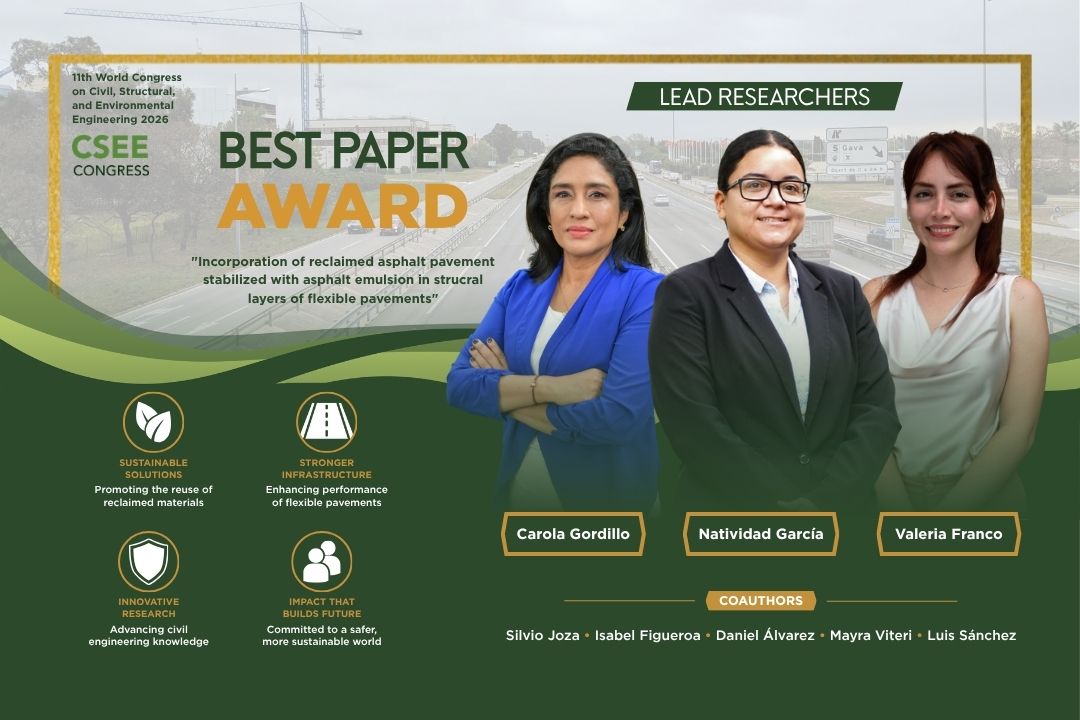
The research was presented virtually by Professor Carola Gordillo on April 16, 2026. Paper ID 126, titled “Incorporation of reclaimed asphalt pavement stabilized with asphalt emulsion in structural layers of flexible pavements” received the Best Paper Award at the conference. This study addresses the rehabilitation of rural roads using recycled asphalt pavement (RAP) stabilized with emulsion, validating its structural performance through methodologies based on international standards. Among its main findings are a reduction of up to 55% in the use of virgin materials, cost savings of up to 34%, and significant improvements in the pavement’s structural capacity, evidenced by a 78% increase in the CBR index. Meanwhile, Paper ID 143, titled “Structural contribution of RAP–granular mixtures stabilized with asphalt emulsion” analyzes the structural contribution of mixtures of RAP with stabilized granular material. This study introduces an approach based on mechanical properties measured in the laboratory, such as the resilient modulus, incorporating them directly into the structural design using the AASHTO methodology. The results show a significant improvement in the material’s stiffness, with values exceeding those of conventional recycled mixtures, which made it possible to reduce the thickness of the asphalt layer by up to 60% without compromising structural performance.
This research contributes to the search for sustainable technical solutions for road rehabilitation, especially in rural contexts with economic and environmental constraints, aligning with ESPOL’s institutional commitment to promoting innovation, resource efficiency, and sustainable development.
The impact of these studies directly benefits students by strengthening their practical training in applied research; faculty, by consolidating lines of research on sustainable infrastructure; and the public and private sectors, by offering viable technical alternatives for optimizing resources in road projects. Furthermore, the goal is to formulate public policies aimed at the use of recycled materials in infrastructure.
Sustainable Development Goals (SDGs)
SDG 9: Industry, Innovation, and Infrastructure, through the development of innovative technical solutions for sustainable road infrastructure.
SDG 12: Responsible Consumption and Production, by promoting the use of recycled materials and the circular economy in construction.
SDG 13: Climate Action, by reducing emissions and energy consumption in construction processes.