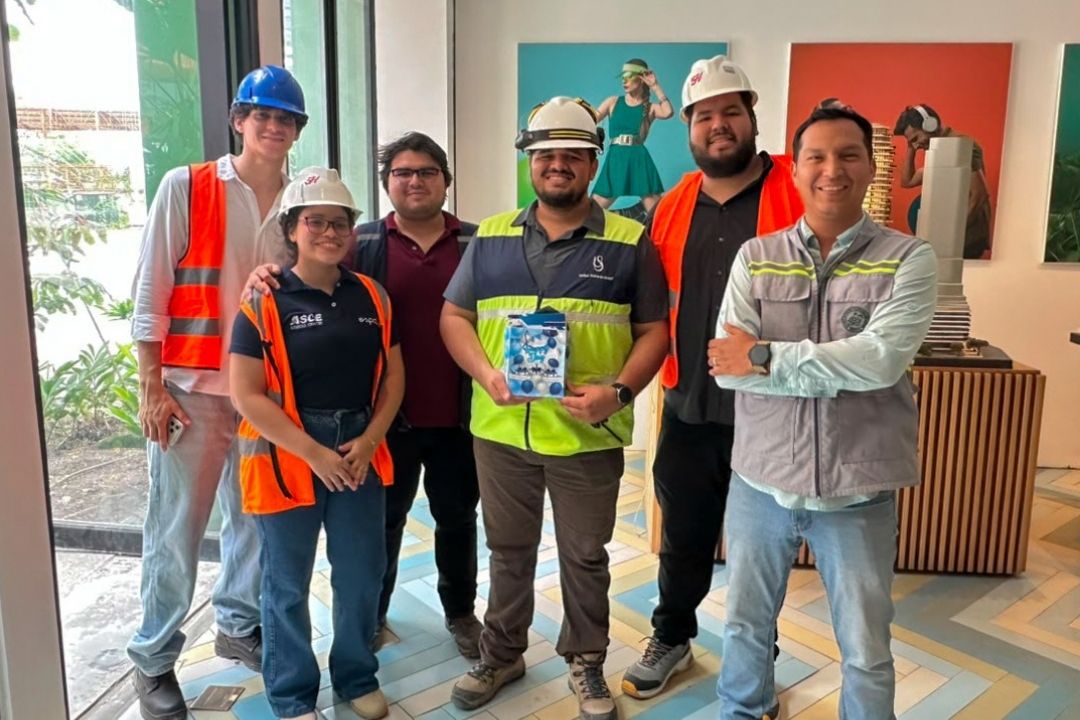


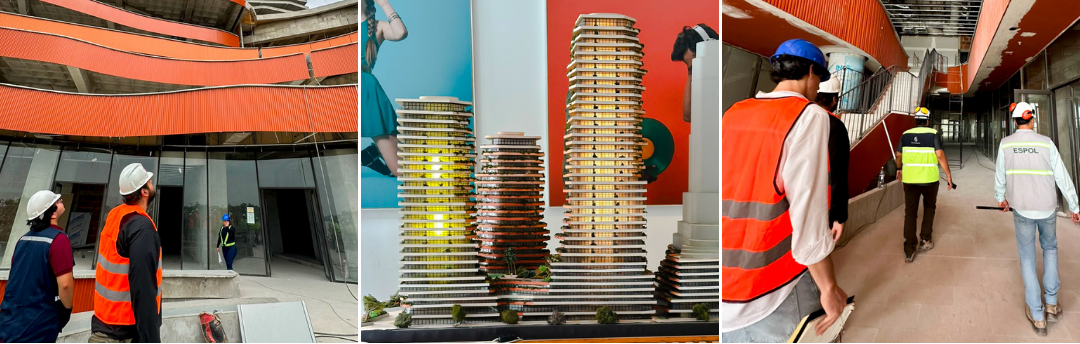
As part of the outreach activities between academia and the construction sector, the student chapter of the American Society of Civil Engineers (ASCE) at ESPOL’s Faculty of Geoscience Engineering (FICT) organized a technical visit to The Hills real estate project, located in Puerto Santa Ana. The event took place on July 18, 2026, and gave students the opportunity to gain firsthand insight into the construction processes and engineering solutions applied in a high-rise building.
Guided by Engineer Nicolaes Sarmiento, the participants toured Tower 1, a 26-story building, and Tower 2, a 24-story building, where they received explanations regarding deep pile foundations, the structural system used, and the strategies adopted to address the area’s geotechnical conditions.
Among the key takeaways, the students learned about the Podium-Tower system, in which the towers are partially interconnected from the foundation level and subsequently develop independently. The earthquake-resistant system was also explained; it is based on reinforced concrete structural walls connected by coupling beams, the principles of which are part of the civil engineering curriculum.
The tour also included a look at Tower 1’s fire protection system and its pump room, designed to ensure a pressurized water supply on all floors. In addition, the decision to locate the parking garages on the first five floors—rather than in underground levels—was explained, due to the high water table in the area. In addition, it was reported that the project includes plans to incorporate photovoltaic solar energy into its lighting system in the future.
Other highlights included the columns, which are inclined at a 12° angle relative to the Y-axis to optimize load transfer to the foundation; the operation of a climbing crane to support the vertical growth of the towers; and the temporary construction waste management practices implemented at the site.
The experience allowed students to gain firsthand exposure to a large-scale construction project and to connect the knowledge acquired in the classroom with the technical challenges posed by engineering in real-world contexts. These types of activities strengthen the link between academia and the construction sector by complementing students’ professional training through the observation and analysis of processes carried out by experienced professionals in the field, thereby contributing to a better understanding of the current challenges in civil engineering and urban development.
Sustainable Development Goals (SDGs)
SDG 9: Industry, Innovation, and Infrastructure. The visit provided an opportunity to learn about civil engineering solutions, structural systems, and innovative construction processes applied to large-scale infrastructure.
SDG 8: Decent Work and Economic Growth. The activity strengthened the students’ professional skills through hands-on learning and exposure to the construction sector.
SDG 11: Sustainable Cities and Communities. The project demonstrates urban development strategies aimed at optimizing the use of space and responding to the conditions of the surrounding environment.