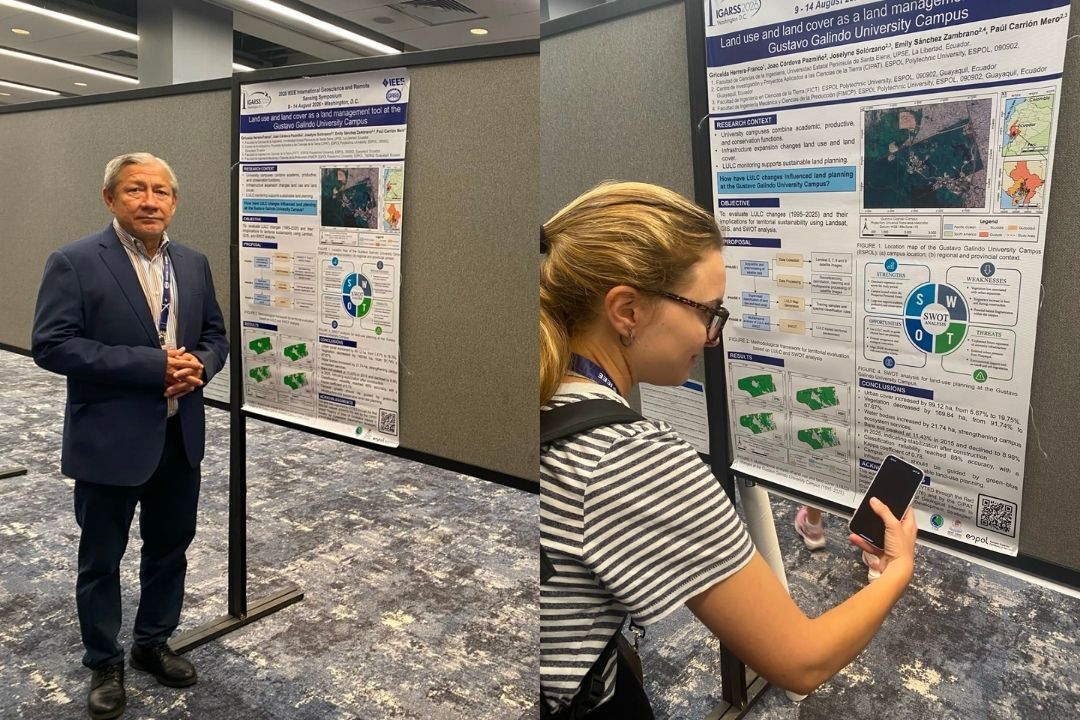


The dean of ESPOL’s Faculty of Geosciences Engineering (FICT), Paúl Carrión, Ph.D., participated in The International Geoscience and Remote Sensing Symposium (IGARSS) 2026, one of the leading international conferences in the field of geoscience and remote sensing, held August 9–14 in Washington, D.C., United States. The central theme of this year’s symposium was “The Future of Earth Observations,” with an emphasis on the development of Earth observation technologies to address environmental and social challenges through global solutions.
During the symposium, the dean presented two research projects developed by the FICT in collaboration with the Center for Research and Applied Projects in Geosciences (CIPAT).
Land use and land cover as a land management tool at the Gustavo Galindo University Campus.
One of these studies analyzes changes in land use and land cover on the Gustavo Galindo campus between 1995 and 2025, using Landsat satellite imagery, remote sensing, and Geographic Information Systems. The study identified an expansion of urban areas and changes in vegetation cover, and proposes technical criteria to support balanced land-use planning that balances academic, productive, and conservation activities.
Remote sensing tools for a strategic plan for forest fire management in an arid zone.
The second study examines the use of remote sensing tools to support wildfire management in an arid region of Ecuador. The study analyzed the 2020 wildfire on Casitagua Hill in Quito using Sentinel-2A imagery and spectral indices, which made it possible to assess the severity of the event and propose a pilot management plan. The proposal takes into account factors such as accessibility, bodies of water, topography, and proximity to educational institutions and health centers, with the aim of supporting decision-making in the face of future events.
“IGARSS, due to its international scope, represents an opportunity to establish networks and cooperation with researchers and professionals from different parts of the world. Every year, this conference opens up new possibilities for future research and collaborations,” noted the dean of the FICT.
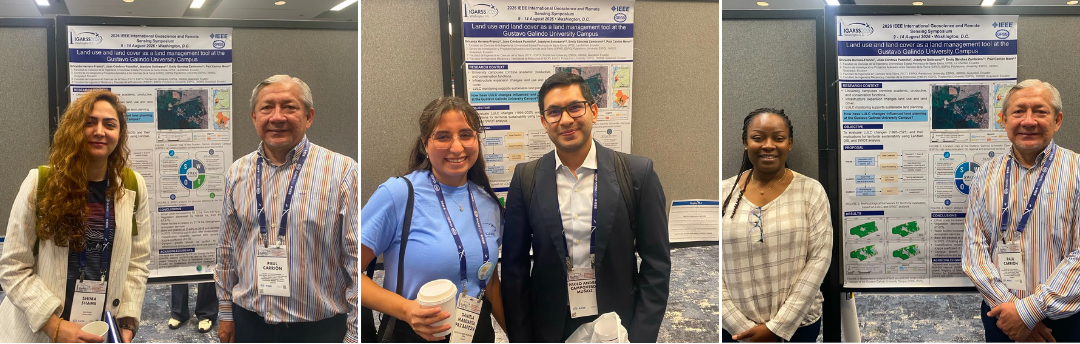
The dean’s participation in IGARSS also helped strengthen ties with members of the FICT alumni community. During the event, he met Paulo Campoverde, an engineering graduate from the Mining program who is currently pursuing a Ph.D. in Chile, and Daniela Paz, a graduate of the Geology program. Both presented work carried out as part of a project led by the FICT associate dean, Kenny Escobar, M.Eng., in collaboration with CELEC EP.
FICT’s presence at this international event thus helps strengthen ESPOL’s connection with global research networks in geosciences and Earth observation. It also allows the work carried out by its researchers to be showcased on the international stage, where technologies and solutions are analyzed to address the challenges facing the region and society.
Sustainable Development Goals (SDGs)
SDG 4: Quality Education. Through FICT’s participation in an international forum for academic and scientific exchange, which enables it to establish ties with researchers and professionals from different regions of the world.
SDG 9: Industry, Innovation, and Infrastructure. Through the international presentation of research conducted at FICT related to remote sensing technologies, Earth observation, and the development of solutions applied to territorial and environmental challenges.
SDG 17: Partnerships for the Goals. By strengthening international networks and creating opportunities for cooperation with researchers and professionals worldwide.