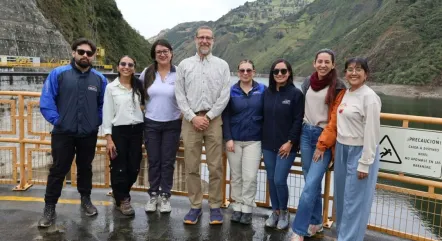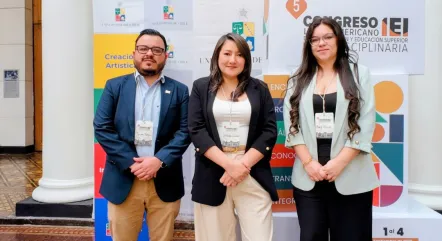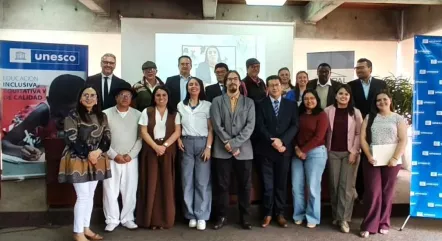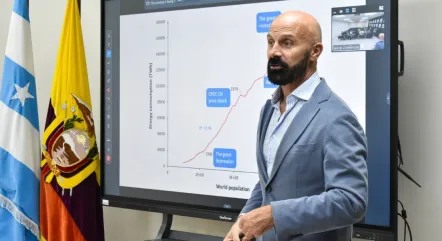

The visit by specialist Mitch Clement, M.Sc., to Santa Cruz Island provided an opportunity to analyze local solutions for water management, learn about irrigation projects, and identify sites of geological interest that could open up new opportunities for interdisciplinary research between ESPOL and the University of Colorado Boulder (CU Boulder).
The academic partnership between ESPOL and CU Boulder expanded its scientific agenda to the Galápagos Islands through a technical visit to Santa Cruz, carried out with the participation of Mitch Clement, M.Sc., a specialist from the Center for Advanced Decision Support for Water and Environmental Systems (CADSWES), alongside faculty and researchers from the School of Earth Sciences Engineering (FICT): Joselyne Solórzano, M.Sc., coordinator of the Geology program, and Daniella Mora, M.Sc.
The activity was part of an international visit coordinated between the two universities and aimed to directly assess local conditions that could serve as settings for future research related to sustainable water management, irrigation, island ecosystems, and geological heritage.
The exchange is part of the cooperation agreement between ESPOL and CU Boulder, administered by Paola Almeida Guerra, Ph.D., a professor at the FCNM. The collaboration between the two institutions has a history of academic exchange programs and summer schools, including an experience held in the Galápagos in 2023 with students and faculty from CU Boulder and ESPOL.
The Galápagos as a Natural Laboratory for Interdisciplinary Research
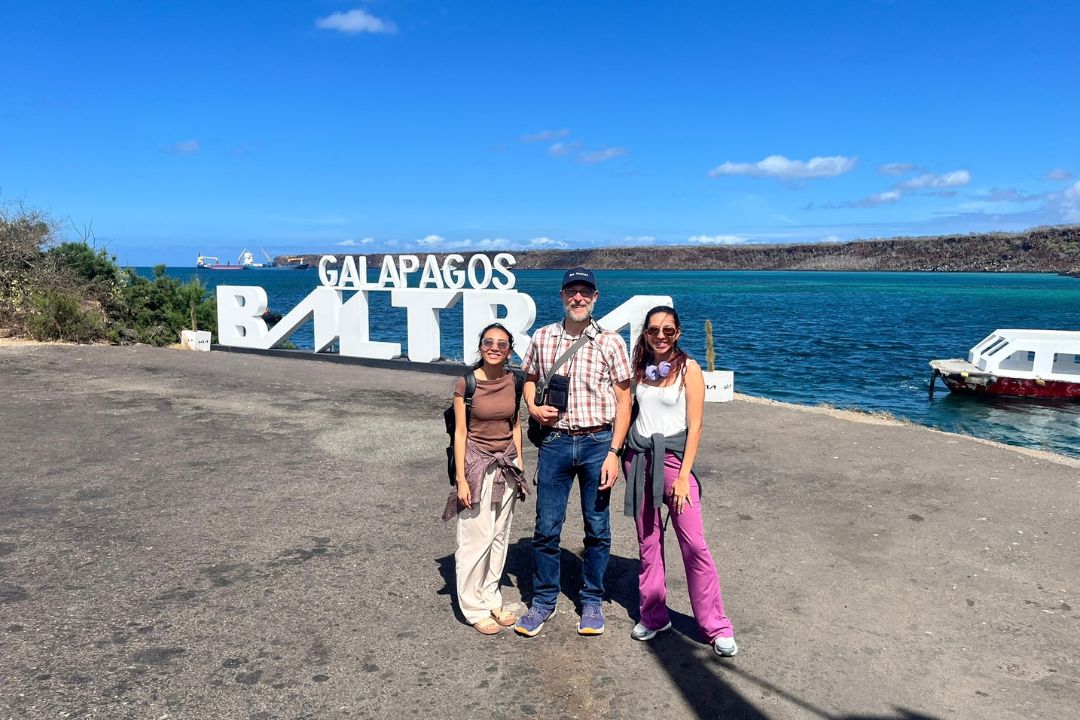
The delegation arrived in Baltra on September 18 and then traveled to Santa Cruz. The technical agenda for September 19 was specifically dedicated to assessing irrigation projects, potential geosites, and opportunities for future collaboration with ESPOL.
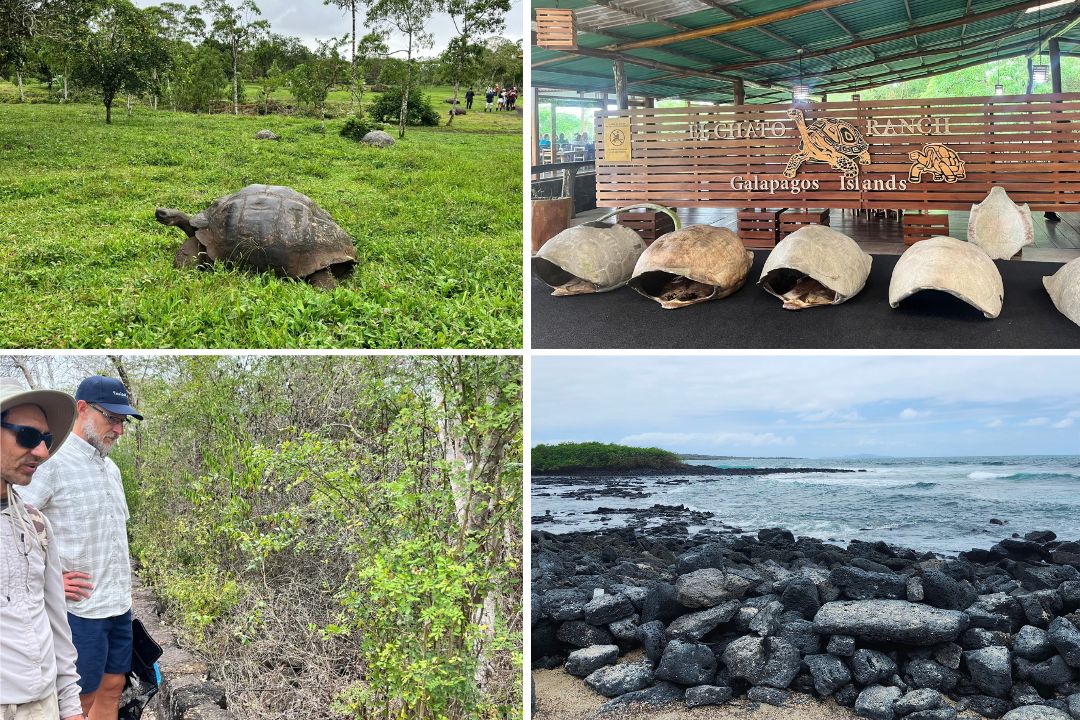
One of the first activities was a tour of areas within the Galápagos National Park, aimed at exploring the ecosystems of Santa Cruz and analyzing the importance of its biodiversity, its endemic species, and the conservation of natural resources.
The visit provided context for the challenges associated with resource management in island territories, where water availability, geological characteristics, and the conservation of sensitive ecosystems must be considered collectively within planning processes.
Water Management and Irrigation on an Island
One of the main themes of the event focused on water use and management in Santa Cruz.
During the tour, participants examined rainwater harvesting systems—including roofing systems and storage structures—used to meet daily needs, support tourism, and provide irrigation.
Observing these practices provided an opportunity to discuss the importance of developing solutions tailored to regions where the availability of freshwater is a determining factor for human and productive activities. This analysis is also grounded in the history of applied research conducted by ESPOL in the province through the Center for Rural Research (CIR) and the Center for Research and Applied Projects in Earth Sciences (CIPAT), both of which have carried out projects related to irrigation and drainage:
Preparation of a study to develop the Galápagos irrigation and drainage plan (CIR-10-2021).
Generation of baseline data for irrigation and drainage projects in the Galápagos Islands (CIR-16-2022).
Studies and final designs for the Camote–Cascajo community irrigation system (Santa Cruz Canton, Galápagos Province).
Training for the agricultural sector in Galápagos Province.
Esta base de trabajo se complementa con más de una docena de artículos científicos publicados por investigadores de la ESPOL, enfocados en el desarrollo agrícola sostenible, sitios de interés geológico, la eficiencia en el uso del agua y la evaluación ambiental en Galápagos. Asimismo, en la FICT opera un grupo de investigación liderado por el profesor Maurizio Mulas, Ph.D., focalizado en el estudio cualitativo y cuantitativo de recursos hídricos y la evaluación de riesgos geológicos y volcánicos en entornos insulares. Noticia completa en : (https://www.fict.espol.edu.ec/es/noticias/fict-espol-fortalece-estudios-para-evaluar-la-estabilidad-de-la-fuente-de-agua-la-camiseta )
Desde esta perspectiva, la experiencia abre oportunidades para estudiar integralmente la relación entre precipitación, captación, almacenamiento, demanda de agua e irrigación, incorporando herramientas de modelación y apoyo a la toma de decisiones como las desarrolladas por CADSWES.
La experiencia de Clement en sistemas de recursos hídricos y optimización aporta una perspectiva complementaria para analizar cómo distintas fuentes y demandas de agua pueden incorporarse dentro de esquemas de planificación que consideren tanto restricciones ambientales como necesidades productivas y sociales.
This body of work is complemented by more than a dozen scientific articles published by ESPOL researchers, focusing on sustainable agricultural development, sites of geological interest, water use efficiency, and environmental assessment in the Galápagos. In addition, a research group led by Professor Maurizio Mulas, Ph.D., operates at FICT, focusing on the qualitative and quantitative study of water resources and the assessment of geological and volcanic risks in island environments. Full article at: FICT-ESPOL is expanding its research to assess the stability of the La Camiseta water source | FICT
From this perspective, the project opens up opportunities to comprehensively study the relationship between precipitation, water collection, storage, water demand, and irrigation, incorporating modeling and decision-support tools such as those developed by CADSWES.
Clement’s expertise in water resource systems and optimization provides a complementary perspective for analyzing how different water sources and demands can be incorporated into planning frameworks that take into account both environmental constraints and productive and social needs.
Geological Territory as a New Line of Research
The visit was not limited to water resources. The itinerary also included an exploration of elements of Santa Cruz’s geological heritage that could become the subject of future studies.
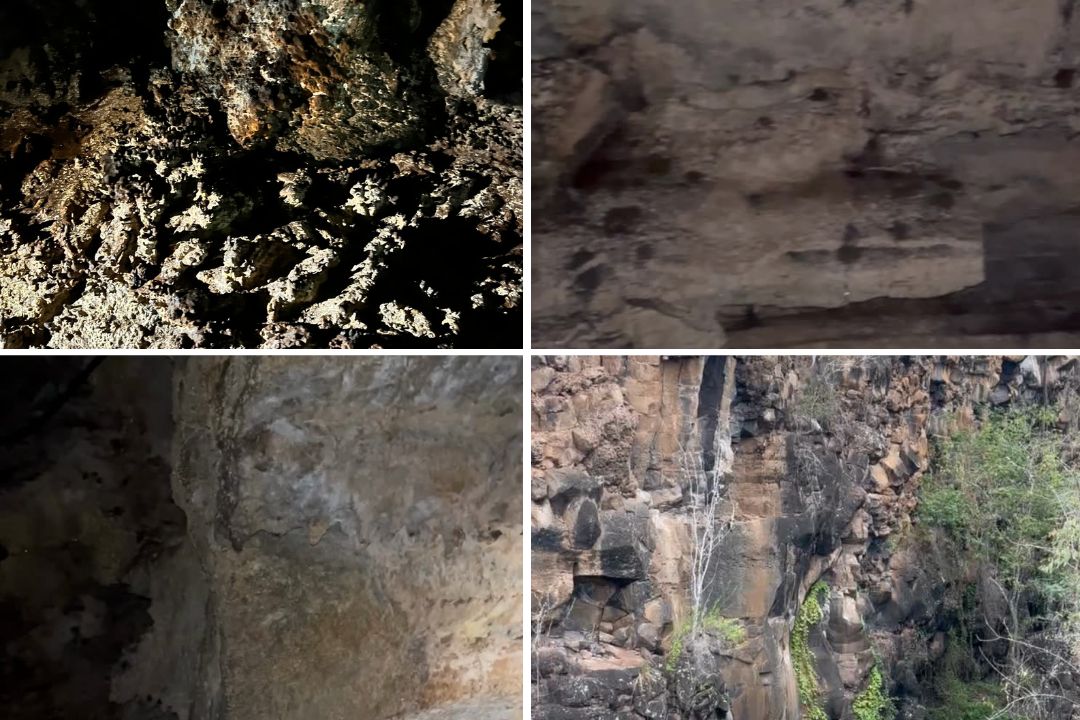
At the “El Chato” ranch, the delegation toured a lava tunnel, which was identified during the visit as a site of potential interest for analysis as a geosite. Subsequently, the delegation visited Los Gemelos, a structure that was likewise identified as a potential site of interest for research related to the Galápagos’ geological heritage.
These sites offer the opportunity to integrate studies in geology, geomorphology, volcanology, conservation, and science outreach, evaluating not only their physical characteristics but also their educational potential and their contribution to the understanding and appreciation of the islands’ natural heritage.
New Opportunities for ESPOL and CU Boulder
The visit to Santa Cruz allowed us to move from a general academic discussion to the direct identification of potential research scenarios.
Based on the observations made during the tour, new possibilities have emerged for exploring future initiatives related to the management and optimization of irrigation systems, rainwater harvesting, analysis of water availability in island environments, characterization of potential geosites, and the development of tools to support sustainable land management.
The visit allowed us to identify problems and opportunities directly in the field, a fundamental step in the formulation of applied research projects.
A long-term partnership
Mitch Clement’s visit to Ecuador is part of a broader cooperation process between ESPOL and CU Boulder, aimed at promoting academic mobility, knowledge exchange, and joint research.
The participation of professors and researchers from various fields at ESPOL also helps expand the scope of the agreement to address issues that require interdisciplinary approaches, particularly those related to water, energy, geology, the environment, and sustainability.
For FICT, the experience in Santa Cruz reinforces the Galápagos’ potential as a natural laboratory for Earth Sciences, where the study of the territory can be linked to specific needs in water management, environmental conservation, and the sustainable use of resources.
In this way, international cooperation between ESPOL and CU Boulder continues to evolve from academic exchange toward the identification of new research questions and projects capable of generating knowledge applicable to the challenges facing Ecuador.
Sustainable Development Goals (SDGs)
SDG 6: Clean Water and Sanitation: Promoting research into local solutions for rainwater harvesting, irrigation systems, and water management models adapted to conditions of water scarcity in island environments.
SDG 15: Life on Land: Promoting the characterization of geological heritage (geosites) and the conservation of biodiversity and fragile ecosystems in the Galápagos Islands.
SDG 17: Partnerships for the Goals: Strengthening international cooperation and research networks between ESPOL and CU Boulder to address territorial sustainability challenges.