
Reducir el consumo energético en los procesos de desalinización es uno de los principales retos para el desarrollo de tecnologías más eficientes de remoción de sales.
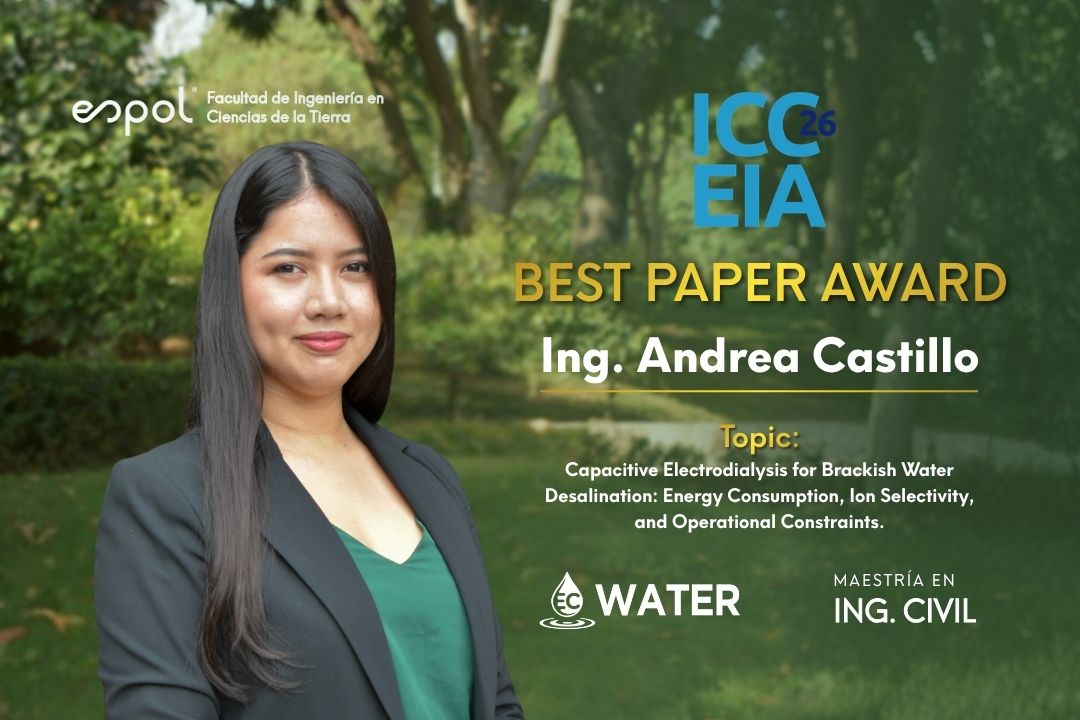
La Ing. Andrea Castillo, estudiante de la Maestría en Ingeniería Civil con mención en Construcción y Saneamiento, de Postgrados ESPOL, recibió el reconocimiento internacional Best Paper Award en la 3rd International Conference on Civil Engineering: Innovations & Advancements (ICCEIA 2026), realizada como parte del 12th World Congress on New Technologies (NewTech 2026) en Reino Unido.
El reconocimiento fue otorgado por la investigación “Capacitive Electrodialysis for Brackish Water Desalination: Energy Consumption, Ion Selectivity, and Operational Constraints”, desarrollada como parte de su proyecto de graduación bajo la dirección científica del Ing. Leonardo Gutiérrez, Ph.D., de la Universidad de Gante (Bélgica), y la Ing. Priscila Valverde, Ph.D., de la Facultad de Ingeniería en Ciencias de la Tierra (FICT) de la ESPOL.
El estudio evalúa la electrodiálisis capacitiva (CED) como alternativa para remover sales presentes en aguas salobres. Bajo las condiciones estudiadas, el proceso alcanzó consumos energéticos de apenas 0.09–0.14 kWh/m³, evidenciando un importante potencial de reducción frente a rangos reportados para tecnologías de electrodiálisis convencional (0.29–2.50 kWh/m³) y ósmosis inversa (0.36–5.00 kWh/m³).
Reducing energy consumption in desalination processes is one of the main challenges in developing more efficient salt removal technologies.
Andrea Castillo, an engineering student pursuing a Master’s degree in Civil Engineering with a concentration in Construction and Sanitation at ESPOL’s Graduate School, received the international Best Paper Award at the 3rd International Conference on Civil Engineering: Innovations & Advancements (ICCEIA 2026), held as part of the 12th World Congress on New Technologies (NewTech 2026) in the United Kingdom.
The award was granted for the research paper “Capacitive Electrodialysis for Brackish Water Desalination: Energy Consumption, Ion Selectivity, and Operational Constraints,” developed as part of her graduation project under the scientific supervision of Leonardo Gutiérrez, Ph.D., from Ghent University (Belgium), and Priscila Valverde, Ph.D., from the Faculty of Geosciences Engineering (FICT) at ESPOL.
The study evaluates capacitive electrodialysis (CED) as an alternative for removing salts from brackish water. Under the conditions studied, the process achieved energy consumption of just 0.09–0.14 kWh/m³, demonstrating significant potential for reduction compared to reported ranges for conventional electrodialysis technologies (0.29–2.50 kWh/m³) and reverse osmosis (0.36–5.00 kWh/m³).
The research is part of a line of work promoted by the EC-Water Academic and Research Network and conducted at the Geoinengineering and Advanced Processes Research Laboratory (GEA-RLab), at the Faculty of Geosciences Engineering (FICT), where membrane technologies and electrochemical processes are studied with the aim of developing increasingly efficient solutions for water treatment, recovery, and reuse.
Sustainable Development Goals (SDGs)
SDG 6: Clean Water and Sanitation
SDG 17: Partnerships for the Goals