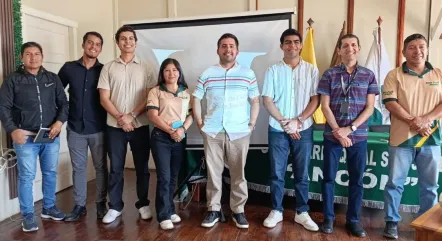


Carola Gordillo, M.Sc., an engineer, professor, and researcher at ESPOL’s Faculty of Geosciences Engineering (FICT), participated as a panelist in Chela Científica #39, titled “El Niño: Science Before the Emergency,” held on Wednesday, August 26, 2026, at the Pop Up Café Theater in Urdesa, Guayaquil. The event was organized by ESPOL Divulga, a program of ESPOL’s Office of the Vice President for Research, Development, and Innovation.
The event provided a forum for outreach and discussion on how to anticipate the impacts associated with the El Niño phenomenon, drawing on various fields of knowledge and sectors of society. This edition brought together perspectives from science, engineering, risk management, infrastructure, logistics, public administration, and citizen participation.
During her presentation, Engineer Gordillo addressed the issue of resilient infrastructure from the perspective of civil engineering. She explained that design, construction, drainage, material selection, terrain characteristics, and maintenance must be analyzed holistically to reduce the vulnerability of roads and other infrastructure to heavy rains, floods, and landslides.
One of the key points raised was the need to analyze a highway as a system and not merely as a pavement structure. This analysis involves the interaction of elements such as the subgrade, granular materials, pavement, surface and subsurface drainage, bridge structures, slopes, road geometry, geotechnical conditions, and maintenance.
Prolonged exposure to water can reduce the bearing capacity of the subgrade and granular materials, accelerate deterioration processes, and increase the likelihood of failures. Therefore, resilience must be incorporated from the study and design stages, taking into account factors such as flood-prone areas, drainage problems, susceptibility to mass movements, material characteristics, and the criticality of each road.
The research professor also highlighted the importance of moving from a predominantly reactive management approach toward a preventive, risk-based one. Under this approach, inspection, maintenance, and addressing critical points become particularly important before the rainy season, with the aim of reducing vulnerabilities and preventing more severe impacts during extreme events.
In the case of rural roads, the discussion also incorporated a social and economic perspective. A disruption to a road can affect a community’s mobility, its economic activity, and access to basic services; therefore, risk assessment must take into account the consequences of a disruption in connectivity, beyond simply the number of vehicles traveling on the road.

La Chela Científica is an initiative of ESPOL Divulga launched in 2023 to promote dialogue among researchers, the private sector, public institutions, and the general public. Through edition #39, more than 38 events had been held on topics related to climate change, biodiversity, innovation, health, sustainability, and regional development.
Also participating in this edition were María del Pilar Cornejo, a professor and researcher at ESPOL, representing the fields of science and risk management; Oswald Arbeláez, Logistics Manager at the DIFARE Distribution Center, representing the private sector and logistics; and Alex Anchundia, General Manager of SEGURA EP, representing the perspective of urban planning and risk management.
For FICT, these types of forums help highlight the role of civil engineering in understanding and addressing the challenges associated with climate events. Engineer Gordillo’s participation underscores the importance of incorporating resilience criteria into the analysis of road infrastructure, linking technical knowledge with the needs of the region and its communities. Sharing this knowledge strengthens the dialogue between academia and society to move toward a more proactive approach to managing the risks that affect the country’s connectivity and development.
Sustainable Development Goals (SDGs)
SDG 9 – Industry, Innovation, and Infrastructure. This initiative promotes the analysis of resilient road and urban infrastructure, incorporating technical criteria to reduce vulnerability and improve its performance in the face of extreme weather events.
SDG 11 – Sustainable Cities and Communities. The discussion directly addresses risk reduction, the preparedness of cities and communities, the continuity of mobility, and access to services in the face of events associated with El Niño.
SDG 13 – Climate Action. This initiative promotes anticipation, adaptation, and risk reduction related to climate events, strengthening the link between scientific knowledge, engineering, and decision-making.