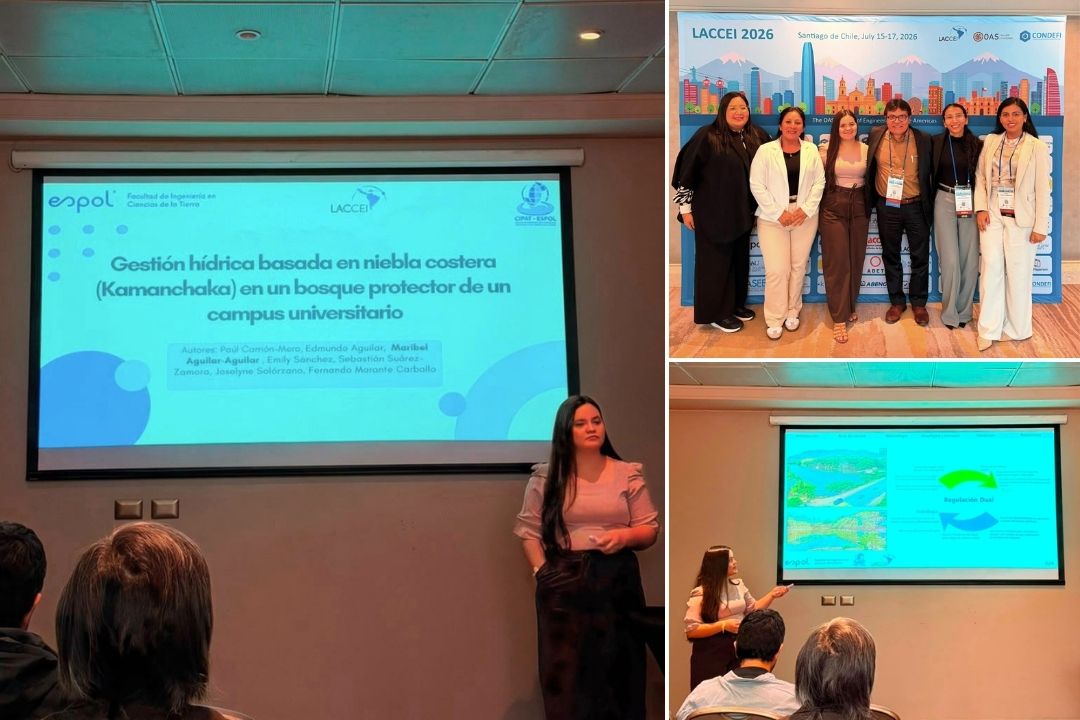
ESPOL’s Faculty of Geosciences Engineering (FICT) participated in the 24th LACCEI International Multi-Conference for Engineering, Education, and Technology, held July 15–17 in Santiago, Chile. At this international conference, research related to humanitarian engineering, engineering education, and integrated water management in communities was presented.
During the conference, scientific articles indexed in Scopus were presented, and opportunities for academic exchange were created with researchers and representatives from institutions in various countries. This participation allowed the FICT to share its research experiences and community engagement initiatives, as well as to strengthen academic collaboration networks.
Among the Faculty’s contributions was the presentation of the scientific article “Water Management Based on Coastal Fog (Kamanchaka) in a Protective Forest on a University Campus,” led by FICT professor and coordinator of the UNESCO Chair in Geosciences Applied to Sustainable Development, Maribel Aguilar, Ph.D. (c). The research is linked to the project “AGUA ESPOL: Geoelectric Exploration of Groundwater to Strengthen Institutional Water Management,” code FICT-007-2026.
This project aims to strengthen sustainable water management and promote the recognition of the ESPOL campus as a UNESCO Ecohydrology Demonstration Site. The research is also linked to the community engagement project “Water Sowing and Harvesting (SyCA): Strengthening Community Resilience,” code PG13-PY26-07, whose expertise in water management based on ancestral knowledge contributed to the UNESCO recognition and serves as a model for sustainable initiatives.
The research is also part of the collaboration with the SbN-GIA Network—Nature-Based Solutions for Integrated Water Management in Vulnerable Communities, of the Ibero-American Program for Science and Technology for Development (CYTED). Within this network, researcher Maribel Aguilar participates as a member of the Ecuadorian group alongside Jóselyne Solórzano, Ph.D. (c), and Emily Sánchez, Ph.D. (c).
FICT’s participation in LACCEI strengthens the integration of research, outreach, and engineering education by creating opportunities to share knowledge and experiences related to social and environmental challenges. These initiatives contribute to an academic education that is connected to the needs of the region and to the search for sustainable solutions for communities.
Scientific article indexed in Scopus
Title: Environmental Impact Assessment of Agricultural Greenhouse Systems in a Natural Heritage Site
Authors:
Eng. Paúl Carrión Mero, Ph.D. (Eng.) - Dean of FICT and Director of the UNESCO Chair in Geosciences Applied to Sustainable Development
Edmundo Aguilar, M.Sc. - Advisor to the UNESCO Chair in Geosciences Applied to Sustainable Development
Eng. Maribel Aguilar Aguilar, Ph.D. (c) - Professor at FICT and Coordinator of the UNESCO Chair in Geosciences Applied to Sustainable Development
Eng. Emily Sánchez Zambrano, Ph.D. (c) - Researcher at CIPAT
Eng. Sebastián Suárez Zamora, M.Sc. - Teaching Assistant at FICT
Eng. Joselyne Solórzano Chauca, Ph.D. (c) - Professor at FICT
Eng. Fernando Morante Carballo, Ph.D. - Director of CIPAT
DOI: https://dx.doi.org/10.18687/LACCEI2026.1.1.2307
Sustainable Development Goals (SDGs)
SDG 6: Clean Water and Sanitation, through research aimed at strengthening sustainable water management.
SDG 11: Sustainable Cities and Communities, through the generation of knowledge and experiences applicable to the sustainable management of territories and communities.
SDG 15: Life on Land, through its connection to the conservation of protective forests and the sustainable use of natural resources.