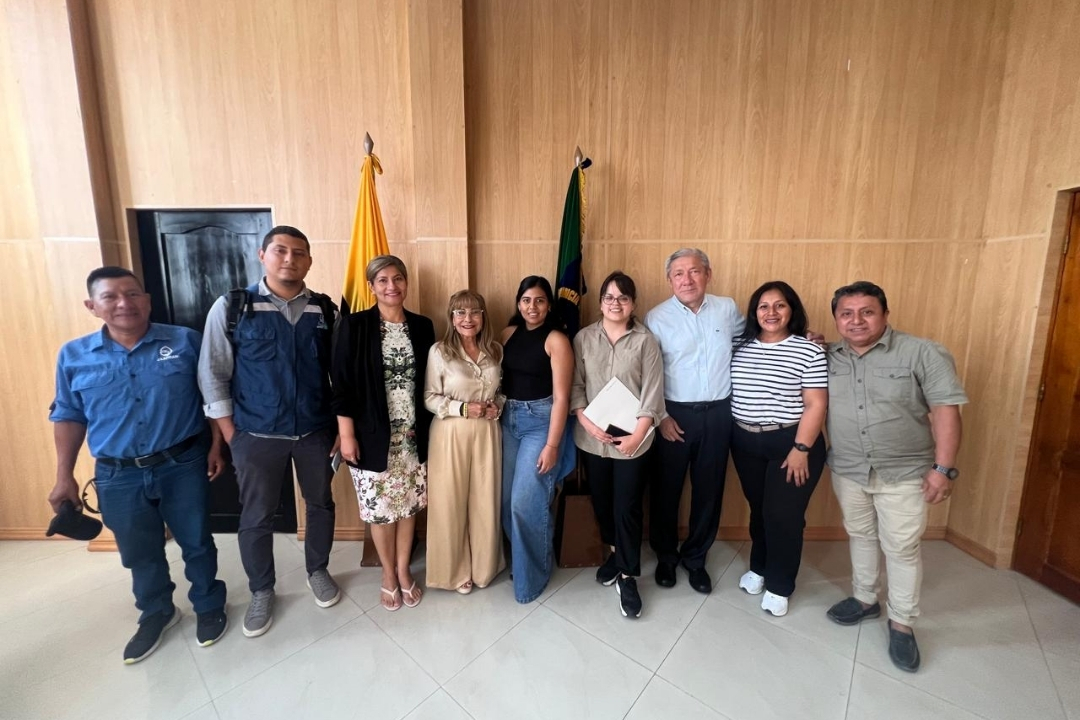


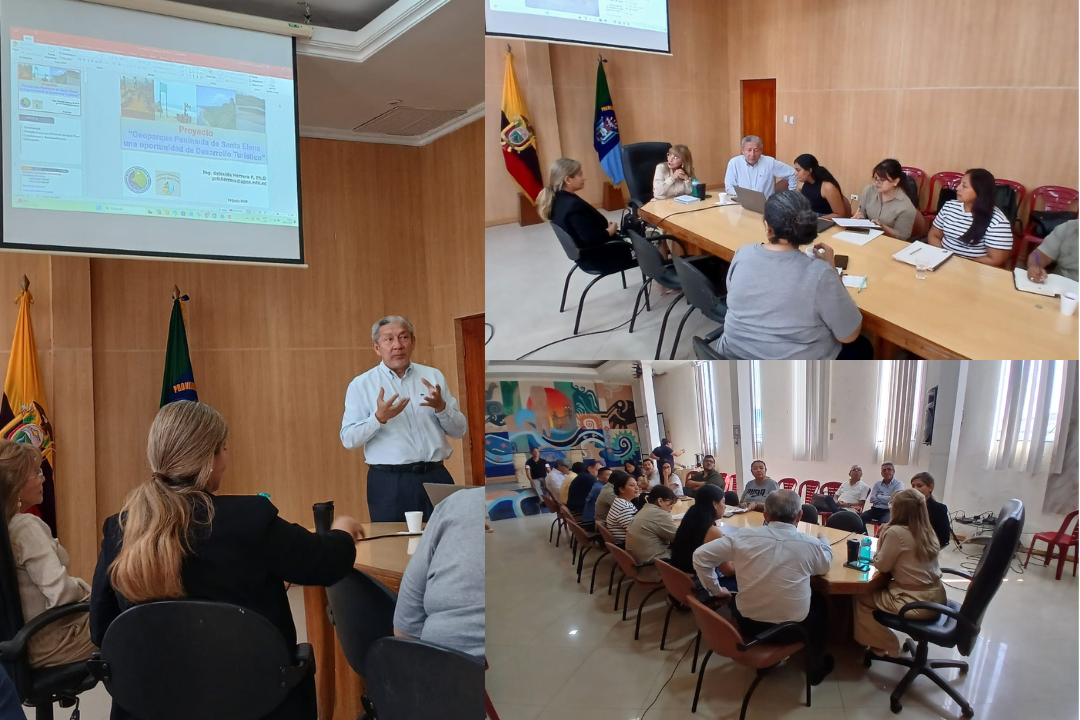
As part of the framework agreement for inter-institutional cooperation between the Escuela Superior Politécnica del Litoral (ESPOL) and the Decentralized Autonomous Provincial Government of Santa Elena, technical staff from the Faculty of Geosciences Engineering (FICT) and the Center for Research and Applied Projects in Geosciences (CIPAT) participated in a working session with officials and technical teams from the Santa Elena Prefecture. The meeting took place on Wednesday, June 24, at the Prefecture’s offices, with the aim of strengthening joint efforts focused on risk management and land-use planning.
During the session, information from the Prefecture’s various departments was reviewed to identify the data needed to develop susceptibility and risk maps for floods and landslides. This analysis made it possible to assess existing information, establish priorities, and determine additional data that will help strengthen these technical products, which are designed to mitigate the impacts associated with the El Niño phenomenon.
The event brought together representatives from the Santa Elena Prefecture’s departments of risk management, water resources, public works, the environment, roads, and development, promoting coordinated efforts between academia and the public sector. This collaboration strengthens the development of technical tools that support decision-making for disaster risk reduction and the protection of communities in the province.
During the meeting, the proposal for the Santa Elena Peninsula Geopark project—an initiative aimed at having the province recognized as a UNESCO Global Geopark—was also presented to the Vice Prefect of Santa Elena, Juana Córdova, and the directors of the Prefecture. The presentation was given by Paúl Carrión, Ph.D., dean of FICT, and Gricelda Herrera, Ph.D., a professor at the Santa Elena Peninsula State University (UPSE), who highlighted the province’s historical, cultural, geological, and paleontological value.
As part of this presentation, CIPAT researcher Emily Sánchez, Ph.D. (c), highlighted the Manglaralto River-Aquifer System as a UNESCO Ecohydrology Demonstration Site, emphasizing its importance as a model for conservation, research, and the sustainable management of natural resources. Also participating were Gloria Malavé, president of the Manglaralto Regional Drinking Water Administrative Board (JAAPMAN), and Sebastián Suárez, M.Sc., a faculty member at FICT, who helped strengthen the ties between public institutions and community organizations.
This event reaffirms ESPOL’s commitment—through FICT and CIPAT—to contribute scientific knowledge and technical expertise to the country’s territorial development, strengthening inter-institutional cooperation to generate solutions that contribute to disaster risk reduction and the sustainable management of resources.
Sustainable Development Goals (SDGs)
SDG 13: Climate Action.
SDG 17: Partnerships for the Goals.