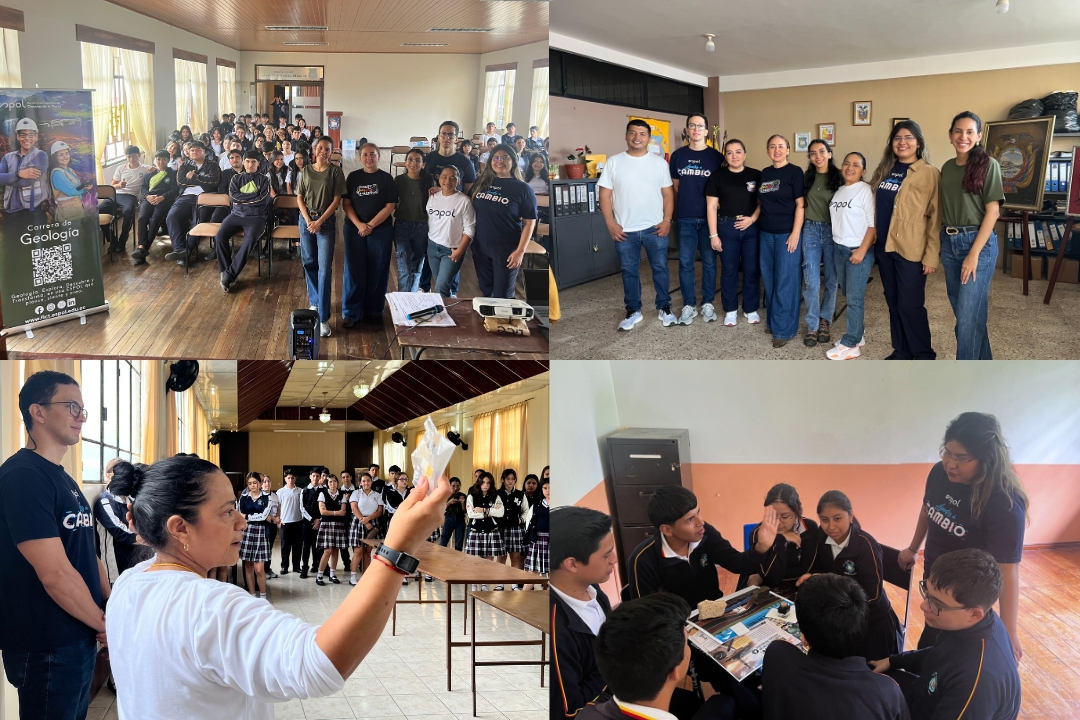


The goal of the academic outreach event organized by ESPOL’s Faculty of Geosciences Engineering (FICT) at various educational institutions in the Zaruma canton was to spark scientific curiosity and demonstrate how Geosciences contribute to sustainable development. Through interactive experiences, high school students gained firsthand insight into the impact of geology and mining on understanding the territory, the responsible management of natural resources, and the prevention of geological hazards.
The initiative took place at Colegio Nacional 26 de Noviembre, Colegio Miguel Sánchez Astudillo, and Colegio San Juan Bosco, where students participated in activities designed to introduce them to the world of geosciences in a practical and dynamic way. By observing and analyzing minerals and fossils, they discovered how these natural records allow us to interpret the Earth’s geological history and understand processes that are fundamental to resource exploration, environmental protection, and sustainable land-use planning.
In addition to presenting the main areas of focus for the Geology and Mining programs, the event allowed attendees to learn about the academic and professional opportunities offered by ESPOL, as well as the importance of training specialists capable of addressing current challenges related to natural resources, infrastructure, the environment, and risk management.
The event was led by Joselyne Solórzano, M.Sc., coordinator of the Geology program, along with Daniella Mora, M.Sc., laboratory technician; Silvana Zambrano, M.Sc., laboratory technician; Diana Mejía, M.Sc., laboratory technician; Jabid Martínez, research technician; and Nancy Zumba, M.Sc., laboratory analyst. The team shared their experiences with the students regarding university education, fieldwork, applied research, and the many professional development opportunities offered by the geosciences, encouraging them to explore a discipline that is essential for understanding and transforming the environment.
As part of the institutional agenda, Joselyne Solórzano, Ph.D., also participated in an interview with a local media outlet, during which she shared her experience in Zaruma and highlighted the academic, scientific, and community engagement projects that ESPOL has developed in partnership with the city. During the interview, the importance of strengthening collaboration between the university and the local community was emphasized, promoting initiatives that contribute to geological knowledge, the sustainable management of natural resources, risk reduction, and the training of talent committed to the region’s development.
This event reflects the FICT’s ongoing commitment to scientific outreach, career guidance, and the training of new generations interested in science and engineering. It also highlights the coordinated efforts of faculty and technical staff to strengthen the bond between the university and the educational community, contributing to ESPOL’s mission of training professionals of integrity who are innovative and committed to the country’s sustainable development. The visit to Zaruma also reaffirms the Faculty’s commitment to building lasting partnerships with local communities, promoting the exchange of knowledge and the development of projects that have a positive impact on society.
Sustainable Development Goals
SDG 4: Quality Education
SDG 9: Industry, Innovation, and Infrastructure
SDG 17: Partnerships for the Goals