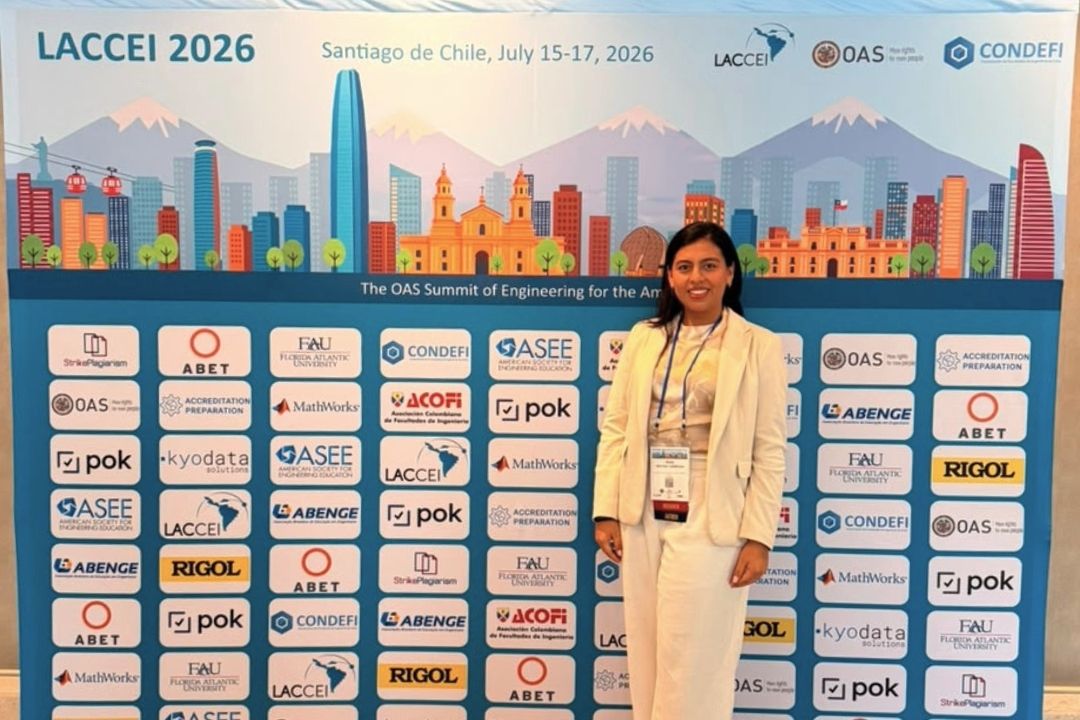


ESPOL’s Faculty of Geosciences Engineering (FICT) and the Center for Research and Applied Projects in Earth Sciences (CIPAT) participated in the 24th LACCEI International Multi-Conference on Engineering, Education, and Technology, organized by the Latin American and Caribbean Consortium of Engineering Institutions (LACCEI), held July 15–17, 2026, in Santiago, Chile. At this international conference, research related to engineering and sustainability was presented, including a study proposing strategies to mitigate the environmental impacts associated with natural gas emissions from oil wells in eastern Ecuador.
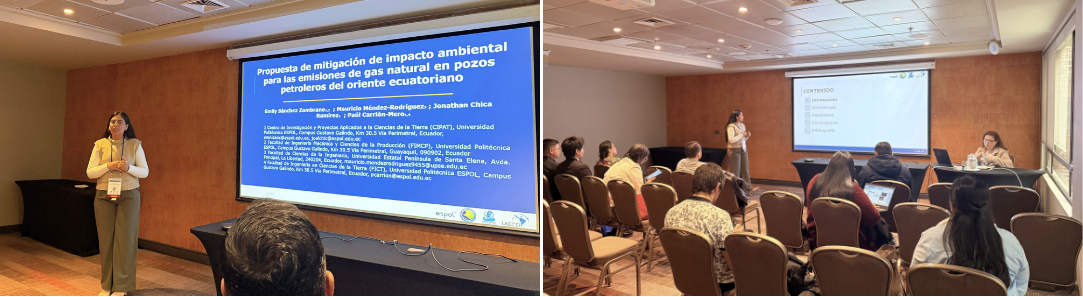
The scientific article “Proposal for Environmental Impact Mitigation of Natural Gas Emissions from Oil Wells in Eastern Ecuador,” indexed in Scopus, was presented by Emily Sánchez, M.Sc., a researcher at the Center for Research and Applied Projects in Earth Sciences (CIPAT). In addition, the article is part of the Master’s in Petroleum program at the Universidad Península de Santa Elena (UPSE) and was conducted in collaboration with the CYTED International Network “Nature-Based Solutions for Integrated Water Management (SbN-GIA).”
The research addresses the flaring of gas associated with oil extraction in the Ecuadorian Amazon and analyzes its impacts on air quality, ecosystems, and local communities. To this end, the study conducted a systematic review of the literature and technical and regulatory documentation, supplemented by a focus group comprising six experts from various fields related to the oil industry and the environment.
Based on this review, the study identified more than 400 active flares and 295 flaring sites not officially registered. Given this situation, the proposal outlines alternatives such as the phased elimination of routine flaring, closed venting systems, leak detection and repair programs, recovery of liquids from natural gas, and electricity generation through the use of associated gas.
Among the alternatives analyzed, the study estimates an increase of up to 30% in LPG production through the recovery of gas liquids and an energy potential of nearly 70 MWh from the use of associated gas. The study specifies that these figures are estimates based on secondary data and that their implementation will depend on factors such as financing, regulatory incentives, and energy market conditions.
The participation of FICT and CIPAT in LACCEI provided an opportunity to share research findings and strengthen avenues for academic exchange with researchers and institutions from other countries. The presentation of this work highlights the contribution of university research to identifying technical and environmental solutions to challenges affecting communities, ecosystems, and strategic sectors of the country.
Scientific article indexed in Scopus
Title: Proposal for environmental impact mitigation of natural gas emissions from oil wells in eastern Ecuador
Authors:
Eng. Emily Sánchez Zambrano, M.Sc. - Researcher at the Center for Research and Applied Projects in Geosciences (CIPAT)
Mauricio Méndez Rodríguez - Santa Elena Peninsula State University
Jonathan Chica Ramírez - ESPOL's S Faculty of Mechanical Engineering and Production Sciences (FIMCP)
Eng. Paúl Carrión Mero, Ph.D. - Dean of the Faculty of Geosciences Engineering (FICT)
DOI: https://dx.doi.org/10.18687/LACCEI2026.1.1.2315
Sustainable Development Goals (SDGs)
SDG 4: Quality Education, for strengthening research and the training of professionals working on environmental and energy issues.
SDG 9: Industry, Innovation, and Infrastructure, through the analysis of technological alternatives to improve the utilization of associated gas and reduce the impacts of oil production.
SDG 17: Partnerships for the Goals, through academic collaboration among researchers, research centers, and institutions of higher education to address the country’s environmental challenges.