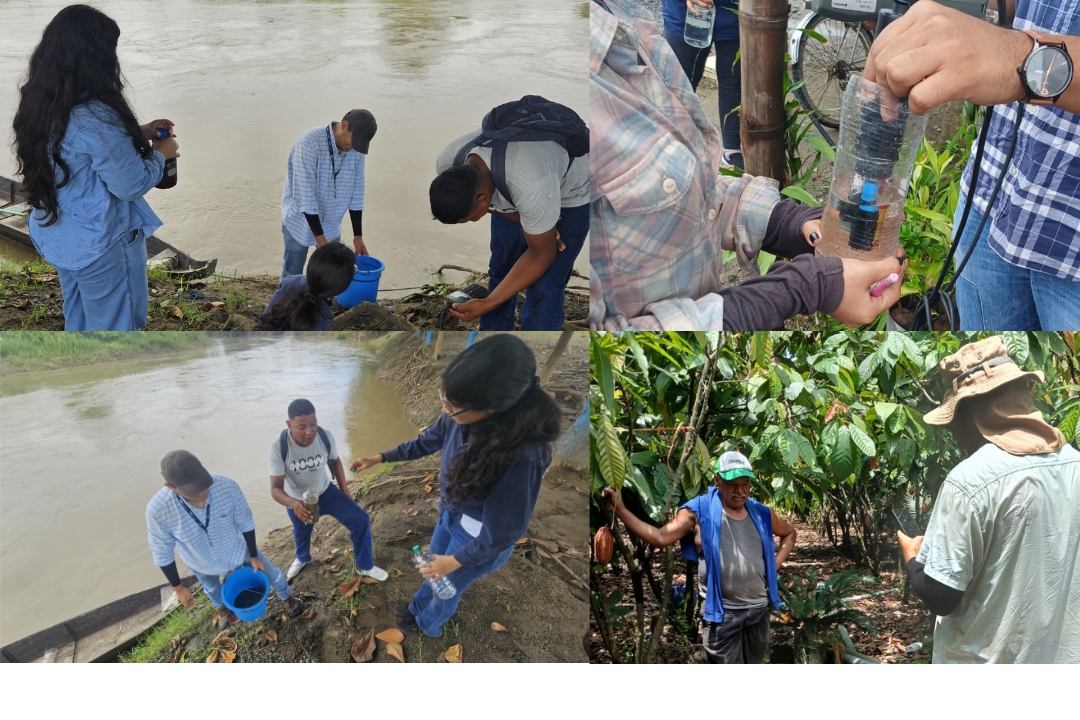

The Escuela Superior Politécnica del Litoral (ESPOL) conducts field activities as part of the international cooperation project “Multi-stakeholder Innovation in Water Management for Local Development in the Bulubulu Basin, Ecuador,” an initiative aimed at strengthening access to water and sanitation, agroecological production, and local water governance. The fieldwork sessions are held monthly at sites located along the banks of the Bulubulu River, between the rural parishes of Virgen de Fátima and Taura, from 8:00 a.m. to 2:00 p.m. During these activities, water samples are collected from community and irrigation wells, as well as from strategic points along the river, which is a key source for local agricultural production. The main objective of this work is to assess the physical-chemical and microbiological quality of the water through systematic monitoring that has been underway since June 2025. This process helps identify variations in contaminants over time, generating relevant information for decision-making regarding the sustainable management of water resources. The project is co-funded by the Valencian Regional Government and the organization Manos Unidas, and involves international partners such as Jaume I University in Castellón, as well as the companies Heliotec and FACSA. At the national level, ESPOL and the Maquita Foundation are participating, reinforcing a collaborative and multidisciplinary approach. At ESPOL, the project is led by the Faculty of Life Sciences (FCV), with support from the Center for Research and Applied Projects in Geosciences (CIPAT) and the Faculty of Geosciences Engineering (FICT), particularly in areas related to drainage and water quality and availability. Notable participants in the project include Emily Zavala, along with students from the Agricultural and Biological Engineering program at the FCV, and Sebastián Suárez from the FICT, who are actively contributing to the collection and analysis of samples in the field. This initiative reflects ESPOL’s commitment to applied research and sustainable development, strengthening integrated water management in rural communities and promoting solutions based on scientific evidence.
Sustainable Development Goals
SDG 5: Gender Equality
SDG 6: Clean Water and Sanitation
SDG 17: Partnerships for the Goals