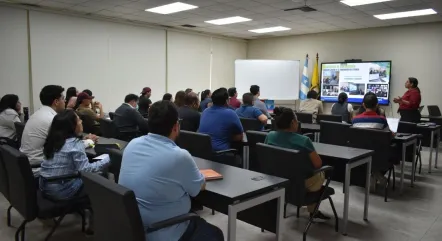

From April 9 to 19, ESPOL hosted a hybrid (in-person and online) course focused on the application of geophysical methods in geotechnical engineering, aimed at master’s students in this field. The first week was led by Professor Danilo Dávila, who covered the fundamentals of geophysical methods and the use of gravimetry and magnetometry in geotechnical engineering.
During the second week, Professors Paúl Carrión, Joselyne Solórzano, and Josué Briones led sessions that updated students’ knowledge of geoelectric techniques and seismic refraction. These tools are essential for decision-making in engineering projects, especially in contexts where subsurface characterization is required.
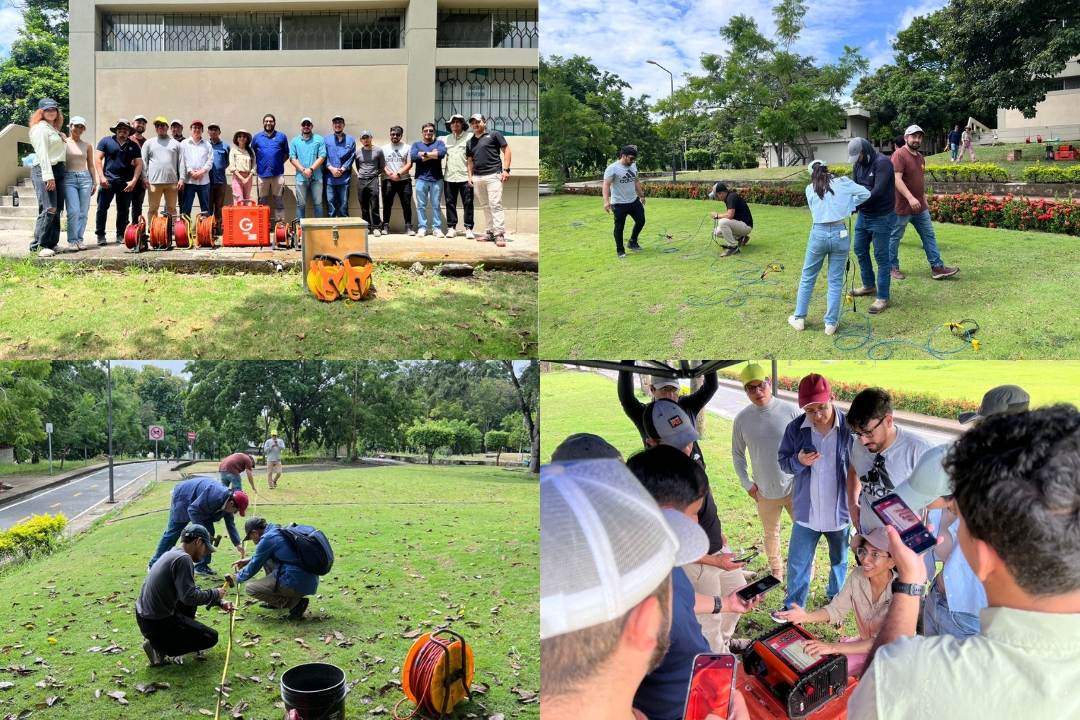
The practical phase included the use of specialized equipment such as the Terrameter LS2 for vertical electrical soundings and electrical resistivity tomography, as well as the Terraloc Pro-2 and a Geometrics ES 3000 seismograph for refraction seismic testing using active and passive measurements. These activities allowed students to bridge the gap between theory and practice, strengthening their technical skills in the field.
In this context, the master’s program in geotechnical engineering demonstrates its contribution to applied research. Under the guidance of Professor Paúl Carrión, nine thesis projects have been developed, resulting in scientific publications in Scopus-indexed journals in the Q1 and Q2 quartiles, in collaboration with Professors Joselyne Solórzano and Josué Briones, as part of institutional research projects.
This initiative helps strengthen the technical skills of graduate students, promoting the generation of applied knowledge and its transfer to the geotechnical sector. In this way, it contributes both to academic training and to the development of solutions for the productive sector and infrastructure planning.
Sustainable Development Goals
SDG 4: Quality Education
SDG 11: Sustainable Cities and Communities