Identifying areas with the greatest groundwater potential represents a step forward for the sustainable planning and management of water resources in the Manabí River Basin District, one of the regions of the country most affected by drought. This study was conducted by researchers from the Escuela Superior Politécnica del Litoral (ESPOL), the Universidad Regional Amazónica Ikiam, and the Universidad Rey Juan Carlos, and was published in Hydrogeology Journal, a scientific journal indexed in the first quartile (Q1) of Scopus. The research presents a model that can guide future efforts in groundwater exploration, monitoring, and conservation.
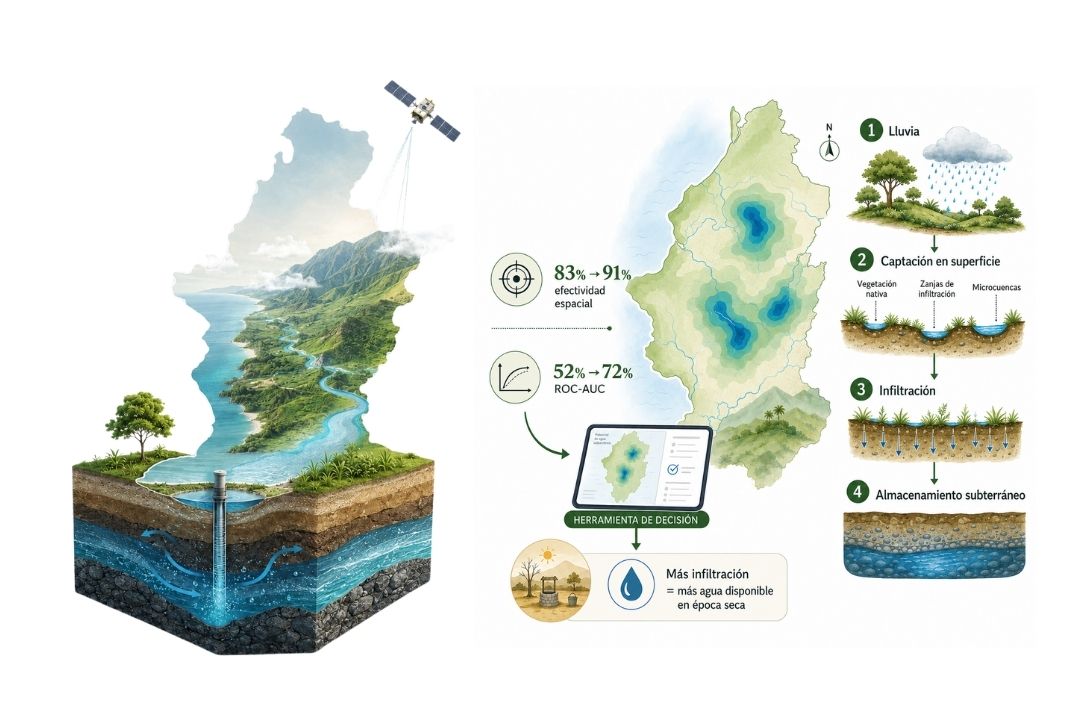
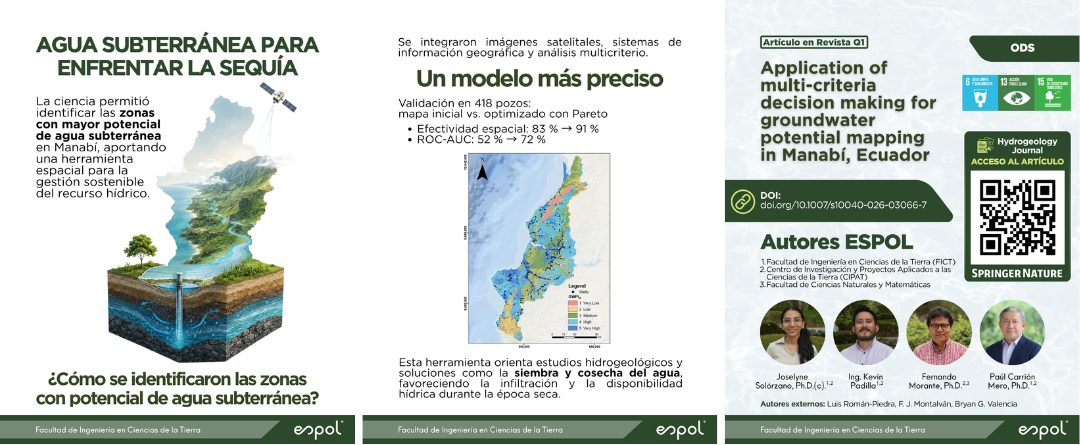
The study developed a groundwater potential map for the Manabí River Basin District by integrating satellite imagery, geographic information systems, multi-criteria analysis, and the Pareto principle. As a result, three variables with the greatest influence on identifying the resource were prioritized: lithology-permeability, geomorphology, and drainage density, which improved the model’s accuracy compared to conventional methodologies.
The model was validated using data from 418 wells inventoried in the study area. The calibrated map achieved a spatial accuracy of 91 percent, higher than the 83 percent obtained by the initial model, while its predictive capacity improved from an ROC-AUC value of 0.52 to 0.72. Furthermore, the analysis determined that 53% of the territory has a high or very high potential for groundwater, concentrated mainly in the Chone and Portoviejo river basins.
The results serve as a support tool for institutions responsible for land-use planning and water resource management, as they enable the prioritization of areas for hydrogeological studies, monitoring, and geophysical prospecting. They also facilitate the implementation of nature-based solutions, such as water harvesting and artificial aquifer recharge strategies, thereby helping to strengthen water security, agricultural activity, and adaptation to drought scenarios.
DOI: doi.org/10.1007/s10040-026-03066-7
ESPOL Researchers
1. Faculty of Geosciences Engineering (FICT)
2. Center for Research and Applied Projects in Geosciences (CIPAT)
Joselyne Solórzano1,2, 3*
Kevin Padilla-Cáceres1,2
Fernando Morante-Carballo2
Paúl Carrión-Mero1,2
Ikiam Amazon Regional University – Faculty of Earth and Water Sciences
Luis Román-Piedra
Bryan G. Valencia
Rey Juan Carlos University – Global Earth Change and Environmental Geology Research Group
F. J. Montalván
3. Polytechnic University of Madrid – Higher Technical School of Mining and Energy Engineering
Sustainable Development Goals - SDGs
SDG 6. Clean Water and Sanitation
SDG 13. Climate Action
SDG 15. Life on Land