
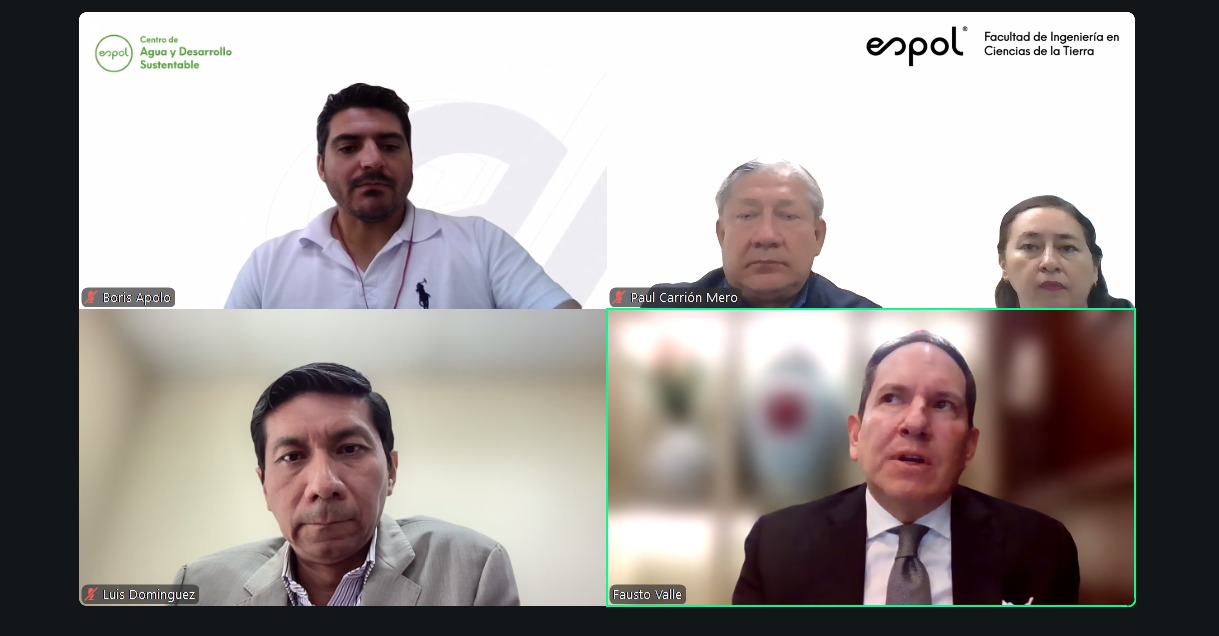
With the aim of contributing to universal access to drinking water and sanitation as fundamental human rights, on February 3, 2026, a virtual session was held between members of the Faculty of Geosciences Engineering (FICT) of the Escuela Superior Politécnica del Litoral (ESPOL) and the Agua para todos Corporation, under the theme “Water and Sanitation for All: the most basic human right.”
The Agua para todos Corporation, a non-profit organization that coordinates efforts between the private sector, academia, and civil society, especially in rural areas of the country, presented its approach and lines of action aimed at promoting sustainable access to drinking water and sanitation. During the meeting, discussions were held on the possibility of establishing a strategic inter-institutional alliance, through which ESPOL would join as a strategic ally and Ambassador for Water and Sanitation, contributing technical knowledge, applied research, and scientific evidence to the national challenge of universalizing these essential services by 2035.
The following individuals participated in this dialogue, Fausto Valle, executive director of the Water for All Corporation; Paúl Carrión Mero, Ph.D., dean of the Faculty of Geosciences Engineering (FICT); as well as ESPOL professors and researchers Luis Domínguez, Ph.D., Suanny Mosquera, Ph.D., and Boris Apolo, M.Sc. In his remarks, Eng. Paúl Carrión highlighted the opportunity to strengthen this collaboration through closer academic participation in the projects currently being carried out by the corporation, reaffirming the FICT's institutional commitment to initiatives with high social and environmental impact.
This inter-institutional coordination will enable the pooling of technical capabilities, foster innovation, and promote joint actions, consolidating the role of academia as a key player in the sustainable management of water resources and basic sanitation, for the benefit of communities and the country's development.
The activity is part of the Sustainable Development Goals (SDGs) of the 2030 Agenda, specifically SDGs 3: Good health and well-being, SDGs 6: Clean water and sanitation, SDGs 11: Sustainable cities and communities, and SDGs 17: Partnerships for the goals, demonstrating ESPOL's commitment to sustainable development and social responsibility.