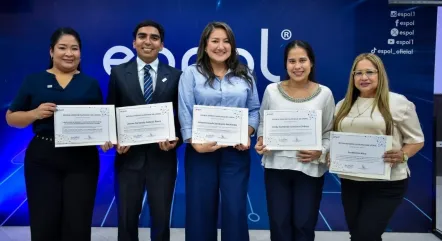
ESPOL’s participation in the 17th International Conference on Concrete Engineering and Technology (CONCET 2026), held August 17–21, 2026, at Universiti Malaya in Kuala Lumpur, Malaysia, included the presentation of the paper “Life Cycle Assessment of Structural Mortars with Partial Replacement of Portland Cement by Diatomite.” As a result, Natividad Garcia, Ph.D., received the Best Presenter award from the conference’s organizing committee.
The study was conducted by Natividad Garcia, Ph.D.; Doménica Cervantes Alvarez; and Hugo Egüez Alava, who are affiliated with the Faculty of Geosciences Engineering (FICT) and the Center for Research and Development in Nanotechnology (CIDNA). The research examines the use of diatomite as a partial replacement for Portland cement in structural mortars, employing the Life Cycle Assessment (LCA) methodology to evaluate its environmental impacts.
The research aims to contribute to the development of more sustainable construction materials by evaluating alternatives to the conventional use of Portland cement. In this context, the application of life cycle analysis makes it possible to study the environmental impacts associated with these materials and generate information for the development of solutions with a lower environmental impact.
The Best Presenter award recognized the presentation skills, effective communication, and clarity in presenting research results demonstrated during CONCET 2026. This achievement helps strengthen the presence of research conducted at ESPOL in international academic forums related to sustainable materials, life-cycle assessment, and the reduction of environmental impact in the construction sector.
Participation in this international conference also provided an opportunity to present research findings to the academic community involved in concrete engineering and materials technology. This initiative is part of ESPOL’s commitment to generating scientific knowledge that helps address key challenges related to sustainable development and the construction sector.

SDG 9: Industry, Innovation, and Infrastructure. For research into and evaluation of alternative materials applicable to the construction sector.
SDG 12: Responsible Consumption and Production. For the study of the use of diatomite as a partial replacement for Portland cement and its potential to contribute to the development of construction materials with a lower environmental impact.
SDG 13: Climate Action. For the application of the life cycle assessment (LCA) methodology to analyze and help reduce the environmental impacts associated with construction materials.