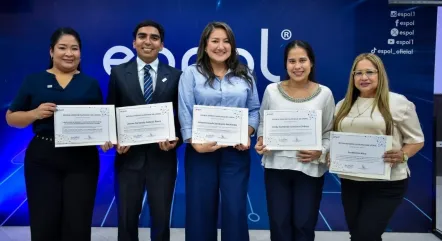
The Faculty of Geosciences Engineering (FICT) at the Escuela Superior Politécnica del Litoral (ESPOL) held the technical conference “Engineering and Assembly of Large Steel Beams” on Friday, July 31, 2026, in the FICT Satellite Lecture Hall. The event brought together officials, faculty, students, industry professionals, and specialists to address technical aspects related to the supervision, fabrication, assembly, and inspection of steel structures.
The event, coordinated by Carlos Quishpe, M.Sc., a professor in the Civil Engineering program at ESPOL, provided an opportunity to connect academic training with professional experiences related to real-world steel infrastructure projects. During the workshop, participants analyzed technical control processes, welding, traceability, the fabrication and assembly of large beams, as well as various methods of non-destructive testing applied to metal structures.

The first presentation was given by Ricardo Javier Arias Quispe, a m echanical engineer and electromechanical specialist with the General Coordination Office for Externally Funded Projects of the Municipality of Guayaquil, who spoke on “Inspection and Technical Control of Metal Structures.” His presentation addressed monitoring and inspection activities applied to the construction of steel structures for vehicular crossings, including the review of welding procedures and non-destructive testing, the control of CNC cutting processes, beveling, ultrasonic inspection, and the storage of segments.
Engineer Arias also explained the importance of inspection and testing plans, document control, and traceability during the various stages of manufacturing. These elements were presented as part of the technical monitoring required to verify the processes associated with the construction of steel structures.

Next, Ariel De Armas Sánchez, a civil engineer, site manager for the PE-MIMG-2024-9 project, and specialist with the municipal contractor Consorcio Guayas, presented on the topic “From the Workshop to the Bridge: Engineering and Assembly of Large Steel Beams.” His presentation explained the sequence of steps for the beams, from their fabrication in the workshop to their final installation, taking into account AWS D1.5 regulations and AISC and ASTM standards.
The presentation covered aspects related to pre-manufacturing documentation, the use of ASTM A588 and A36 steels, workshop welding processes, the transport of segments, on-site receipt and assembly, field welding, the hoisting plan, and the installation of diaphragms and bracing elements.

La tercera intervención estuvo a cargo del Ing. Darío Javier Sánchez Sánchez, Ingeniero Industrial, Inspector de Soldadura Certificado AWS-CWI 14073671 e Inspector Nivel II en PT, MT, UT y RT y especialista de la contratista municipal Consorcio Guayas. En su exposición, “Inspección, defectología y calificación de soldadura”, abordó fundamentos y procesos de soldadura, tipos de juntas, variables esenciales y requisitos aplicables a estructuras y puentes metálicos.
El Ing. Sánchez también explicó la diferencia entre discontinuidad y defecto, los principales tipos de imperfecciones en soldaduras y los documentos WPS, PQR y WPQ. Además, trató temas relacionados con el control de distorsiones, la trazabilidad de materiales, los planes de inspección y pruebas, la gestión de no conformidades y la elaboración de reportes de calidad.

The third presentation was given by Darío Javier Sánchez Sánchez, an industrial engineer, AWS-CWI Certified Welding Inspector (No. 14073671), Level II inspector in PT, MT, UT, and RT, and specialist at the municipal contractor Consorcio Guayas. In his presentation, “Inspection, Defectology, and Weld Qualification,” he addressed the fundamentals and processes of welding, types of joints, essential variables, and requirements applicable to metal structures and bridges.
Mr. Sánchez also explained the difference between discontinuities and defects, the main types of imperfections in welds, and the WPS, PQR, and WPQ documents. In addition, he addressed topics related to distortion control, material traceability, inspection and testing plans, nonconformity management, and the preparation of quality reports.

The conference concluded with a question-and-answer session, during which attendees engaged in dialogue with the experts and explored the topics covered in the presentations in greater depth. The event contributed to technical updates and the analysis of best practices applied to steel infrastructure projects, strengthening the link between the Civil Engineering program and industry professionals.
Through events like this, FICT fosters a connection between academic training and professional experience, exposing students to the criteria, processes, and standards used in the fabrication, assembly, inspection, and quality control of steel structures. The event also provided an opportunity to address the quality of these processes at various stages of the project, from supervision and fabrication to the inspection and verification of welds.
Sustainable Development Goals (SDGs)
- SDG 4: Quality Education, for creating a space to update and strengthen technical knowledge for students and members of the academic community.
- SDG 9: Industry, Innovation, and Infrastructure, for addressing processes, standards, and best practices related to the manufacturing, assembly, inspection, and quality control of metal infrastructure.