
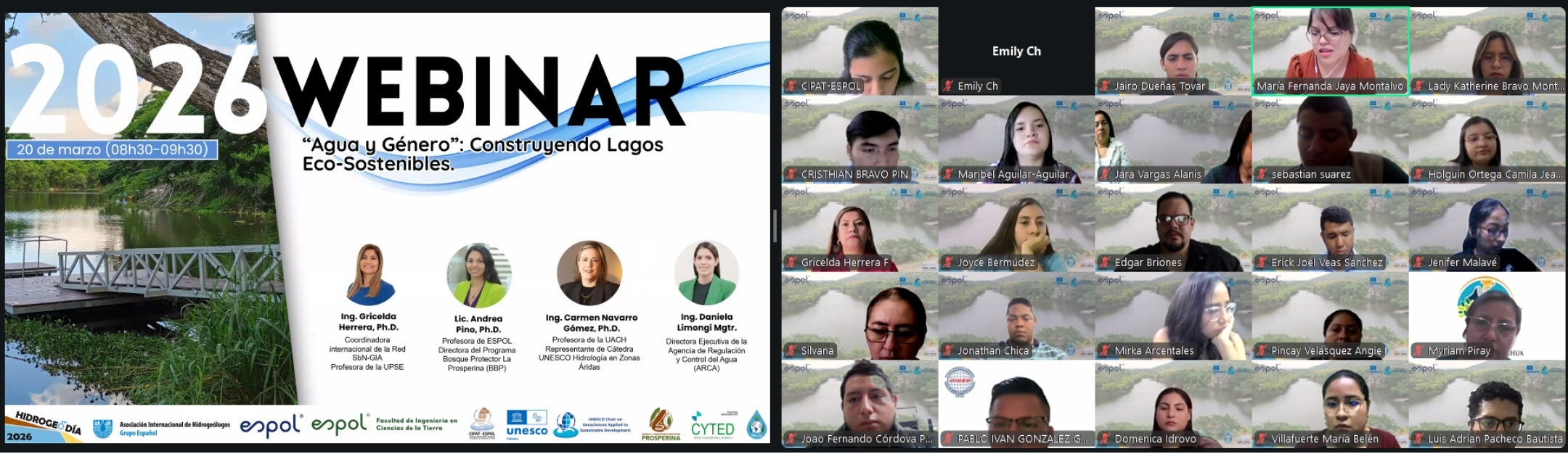
As part of World Water Day, the Escuela Superior Politécnica del Litoral (ESPOL), through the first UNESCO Chair in Geosciences Applied to Sustainable Development, the Center for Research and Applied Projects in Geosciences (CIPAT), and the Faculty of Geosciences Engineering (FICT), organized the webinar “Water and Gender: Building Eco-Sustainable Lakes,” an academic forum designed to reflect on the sustainable management of water resources from a perspective of equity and inclusion.
The event brought together more than 90 participants from the academic and professional communities, establishing itself as a platform for the exchange of knowledge and experiences regarding the role of women in research, technical management, and decision-making related to water. The session highlighted women’s leadership in the scientific field, demonstrating their contribution to the development of innovative solutions for water sustainability.
During the webinar, four presentations were delivered by national and international experts:
“CYTED Network for International Cooperation: An Approach Based on Nature-Based Solutions,” presented by Gricelda Herrera, Ph.D., international coordinator of the SbN-GIA Network and professor at the Santa Elena Peninsula State University.
“Designing Sustainable Identities: Demonstration Forests as Natural Infrastructure and Learning Spaces,” presented by Andrea Pino, Ph.D., professor in the Faculty of Art, Design and Audiovisual Communication.
“Women’s Leadership in Technical Management for Sustainable Transformation: A Perspective from Hydrogeology,” presented by Carmen Navarro, Ph.D., researcher at the Autonomous University of Chihuahua.
“The Role of Women in Water Managemfent and Their Participation in Decision-Making Spaces,” presented by Daniela Limongi, M.Sc., representative of the Water Regulation and Control Agency.
The presentations highlighted experiences and approaches that strengthen water governance from an inclusive perspective, emphasizing women’s contributions to the development of policies, projects, and strategies that promote environmental sustainability and the responsible use of water resources.
Through such initiatives, ESPOL reaffirms its commitment to creating academic spaces that promote gender equity, knowledge exchange, and inter-institutional cooperation, contributing to the development of scientific solutions to global water-related challenges.