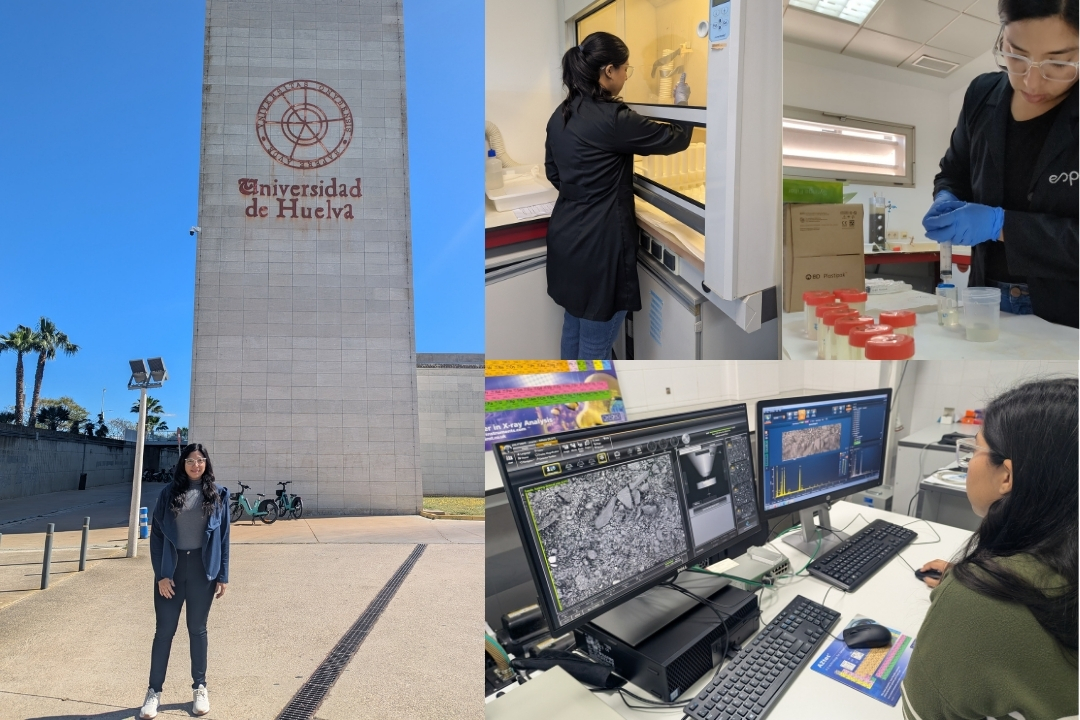

From April 13 to 24, 2026, Karla Villamar Marazita, a laboratory technician at ESPOL’s Faculty of Geosciences Engineering (FICT), conducted a technical visit to the University of Huelva in Spain as part of the project “Assessment of the Recovery Potential of Critical Minerals Present in Mining Waste: Sustainable and Strategic Mining.”
The purpose of the technical visit was to conduct microstructural and compositional characterization of mining tailings samples using scanning electron microscopy (SEM), thereby contributing to the analysis of the recovery potential of critical minerals present in mining tailings. This initiative aims to promote sustainable alternatives for the utilization of these materials and to strengthen applied research in sustainable mining.
During the visit, sample preparation and digestion processes were carried out for analysis via ICP-MS, as well as activities to characterize mining tailings. These actions generated relevant technical information for the study of mining tailings and their potential strategic use, contributing to the development of solutions aimed at more responsible and efficient production of mineral resources.
The technical agenda also strengthened scientific and institutional collaboration between ESPOL and the University of Huelva through the exchange of knowledge and experiences in the fields of Earth sciences and environmental geochemistry.
The visit took place under the supervision of Dr. José Miguel Nieto Liñán, a researcher with the Mineralogy and Environmental Geochemistry Group at the University of Huelva and an honorary researcher for the project; Alberto Molinero García, an assistant professor at the University of Seville; and Ricardo Millán Becerro, a postdoctoral researcher at the University of Huelva.
Sustainable Development Goals (SDGs)
SDG 9: Industry, Innovation, and Infrastructure
SDG 12: Responsible Consumption and Production