


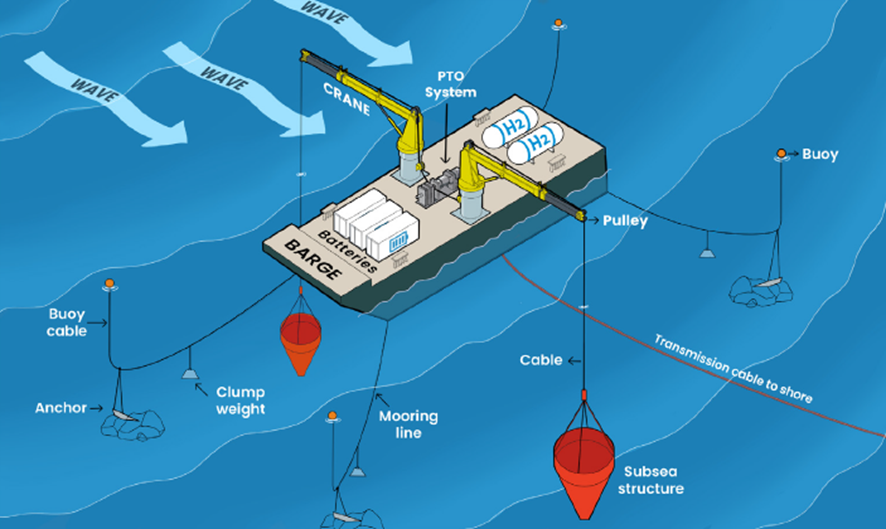
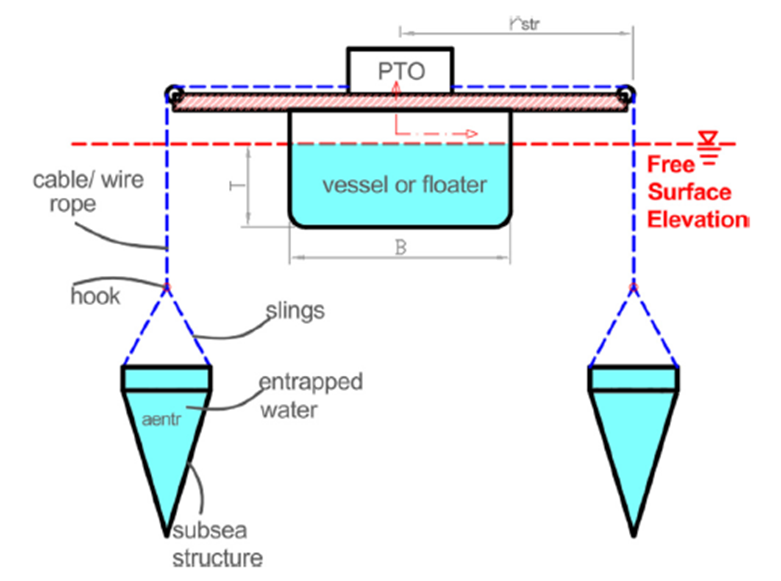
This study evaluated the use of passive wave energy converters (WEC) to tackle the classic problem of mismatch between higher frequencies of typical devices and the natural values observed in ocean waves. This was carried out by means of the inclusion of inverted cone-shaped submerged structures, entrapping seawater during upward motion, increasing thus mass, and lowering the natural frequency.
What does the research consist of?
The research evaluated the use of passively tuned wave energy converters, by incorporating submerged inverted cone-shaped structures capable of trapping seawater during the system's upward movement. This mechanism increases the effective mass of the converter and allows its natural frequency to be reduced, improving its adaptation to different wave climates.
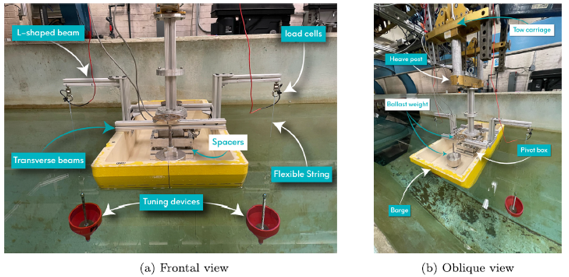
Tests were carried out at several lab facilities: Aquaculture Tank, and Wave Tank (FIMCM), Hydraulic flume (FICT-Institutional), and the Davidson Laboratory (Stevens Institute of Technology, NJ, USA), using a 1:40 scale models. With a Capture Width Ratio (CWR) of 52% and incorporating irregular wave spectra, common in swell dominated seas, the models exceeded the typical 20-40% of conventional WECs.
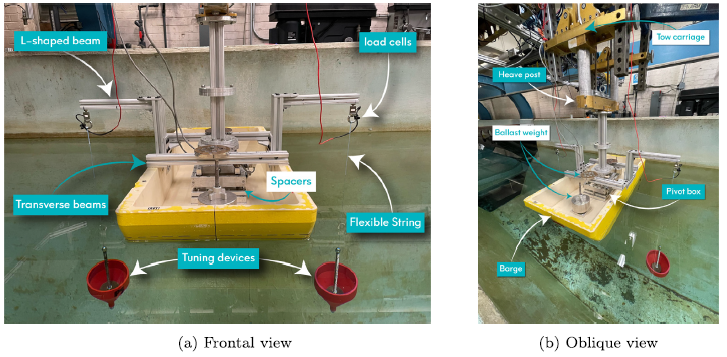
By combining high efficiency, robustness, and structural simplicity, this low-cost, scalable approach addresses a long-standing limitation of WECs and provides a viable pathway toward full-scale deployment with integrated power take-off damping and adaptation to diverse wave climates.
Research tean
FIMCM – ESPOL
Rubén J. Paredes, Ph.D.
Paul S. Zambrano, Ph.D.
José R. Marín-López, Ph.D.
FICT – ESPOL
Mijail Arias-Hidalgo, Ph.D.
Stevens Institute of Technology, EE. UU.
David Plaza
Raju Datla
Muhammad R. Hajj
Universidad Austral de Chile
José M. Ahumada
Escuela Politécnica Nacional (EPN)
Ricardo Alvarez-Briceño
Wilson Guachamín-Acero
Jesús Portilla-Yandún