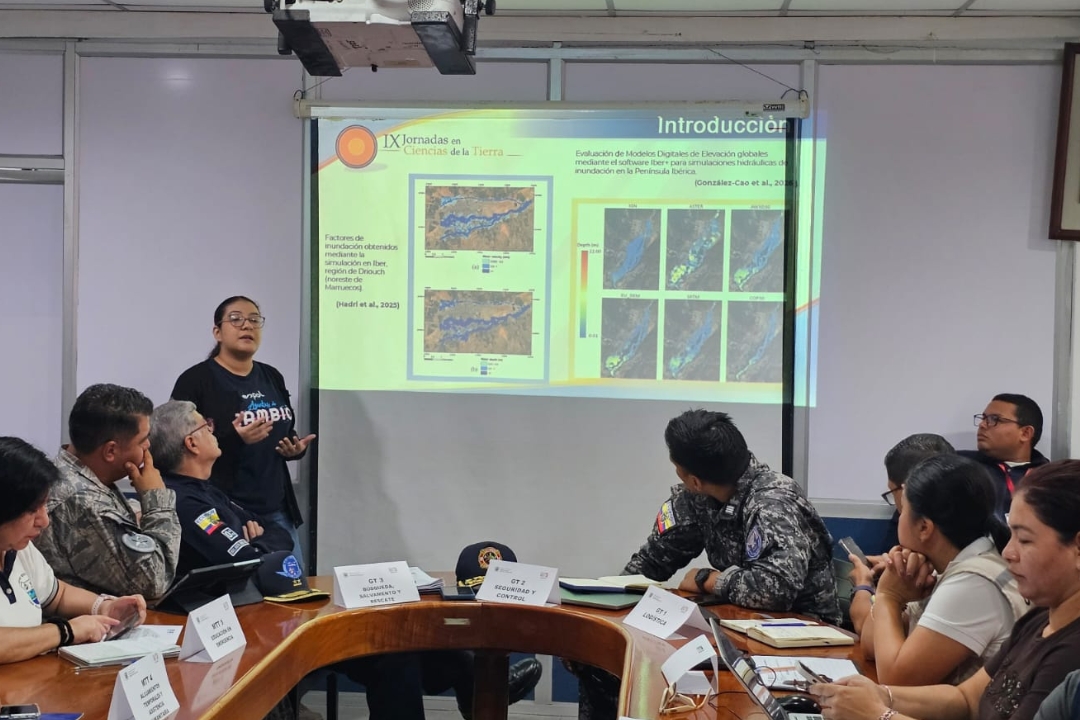


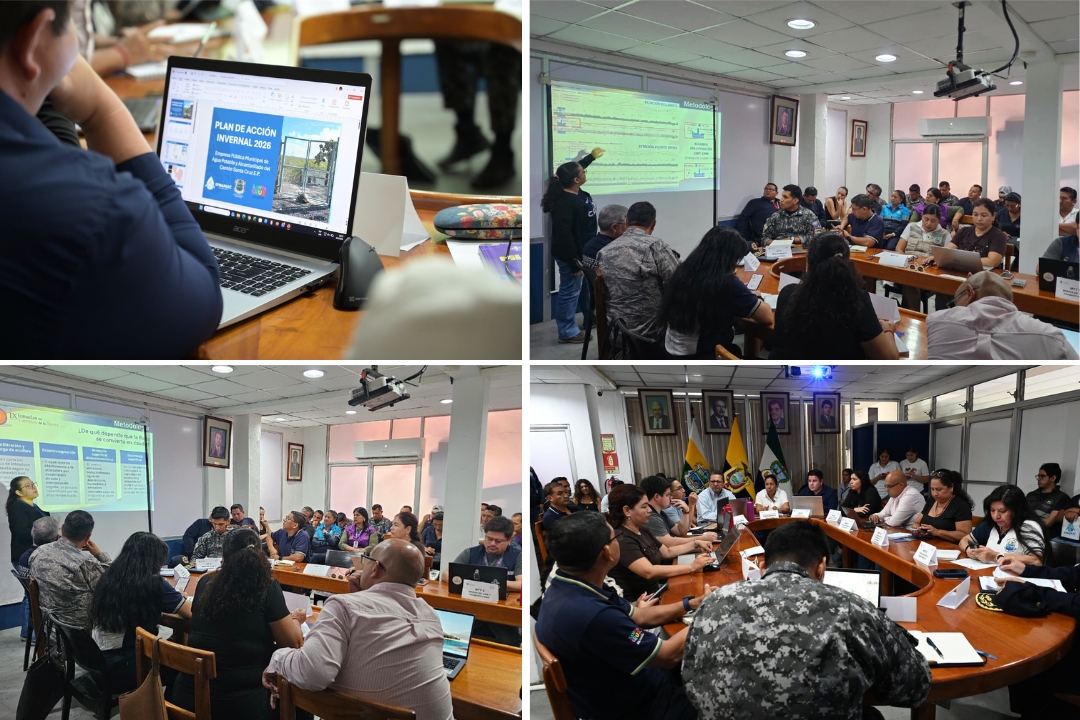
The Escuela Superior Politécnica del Litoral (ESPOL), through the Faculty of Geosciences Engineering (FICT) and in collaboration with the Santa Cruz Public Water and Sewerage Company (EPMAPASC), participated in the extraordinary activation session of the Santa Cruz Cantonal Emergency Operations Center (COE), held on September 3, 2025, in the Session Hall of the Decentralized Autonomous Municipal Government of Santa Cruz, in Galápagos. The participation took the form of technical support for Technical Working Group 1 (MTT1) – Water and Sanitation.
During the event, Engineer Victoria Rosado, M.Sc. (c.), a Research Technician 1 Tc at FICT, provided technical support to MTT1 and led the presentation on “2D Hydrological-Hydraulic Modeling of Surface Flow Dynamics in Volcanic Island Watersheds: A Case Study of Santa Cruz, Galápagos.”
This tool enables the generation of technical information on surface flow dynamics and contributes to the analysis of potential flood scenarios in the event of hydrometeorological events. The purpose of the presentation was to share the results of the modeling with the various Technical Working Groups and teams that make up the Cantonal Emergency Operations Center (COE), as technical input for their information and consideration.
This information is intended to contribute to preparedness, prevention, planning, and decision-making regarding potential scenarios associated with the 2026–2027 El Niño phenomenon. In this context, the 2D hydrological-hydraulic model serves as a technical tool to support the identification and analysis of areas potentially affected by flooding.
Its application can help ensure that the responsible institutions have scientific information to strengthen risk management in the face of heavy rainfall scenarios. It also supports the planning of preventive actions and institutional coordination in response to potential extreme hydrometeorological events.
This initiative is part of the collaboration between FICT, ESPOLTECH, and EPMAPASC, aimed at strengthening the generation and application of technical and scientific information to address the region’s needs. The coordination among these institutions links academic and technical capabilities with local risk prevention and management processes.
The information developed seeks to contribute to institutional preparedness and the protection of the population of Santa Cruz. In this way, the research and specialized knowledge generated by ESPOL are incorporated as tools to support territorial management and decision-making.
Key Figures:
ESPOL-FICT / ESPOL-TECH
Victoria Rosado, Engineer, M.Sc. (c.) – Research Technician 1 Tc, providing technical support to MTT1 and responsible for presenting the 2D hydrological-hydraulic model.
Participating Institutions:
Decentralized Autonomous Municipal Government of Santa Cruz / Cantonal Emergency Operations Center (COE)
Fanny Uribe, Esq. – Mayor of the Santa Cruz canton and chair of the extraordinary session of the Cantonal Emergency Operations Committee (COE).
Santa Cruz Municipal Public Water and Sewer Company, E.P. (EPMAPASC E.P.). – MTT1 Water and Sanitation
Paolo Zambrano, MSc. – General Manager and Coordinator of Technical Working Group 1 (MTT1) – Water and Sanitation.
Diego Ango, MSc. – Water Quality Analyst and member of MTT1 – Water and Sanitation.
Related SDG
SDG 6: Clean Water and Sanitation. For providing technical information to manage scenarios that may affect water-related systems and resources.
SDG 11: Sustainable Cities and Communities. For contributing to the analysis of potential flood scenarios and to strengthening disaster preparedness and risk management in Santa Cruz.
SDG 13: Climate Action. For generating technical knowledge that can support prevention and adaptation to hydrometeorological events associated with climate phenomena.