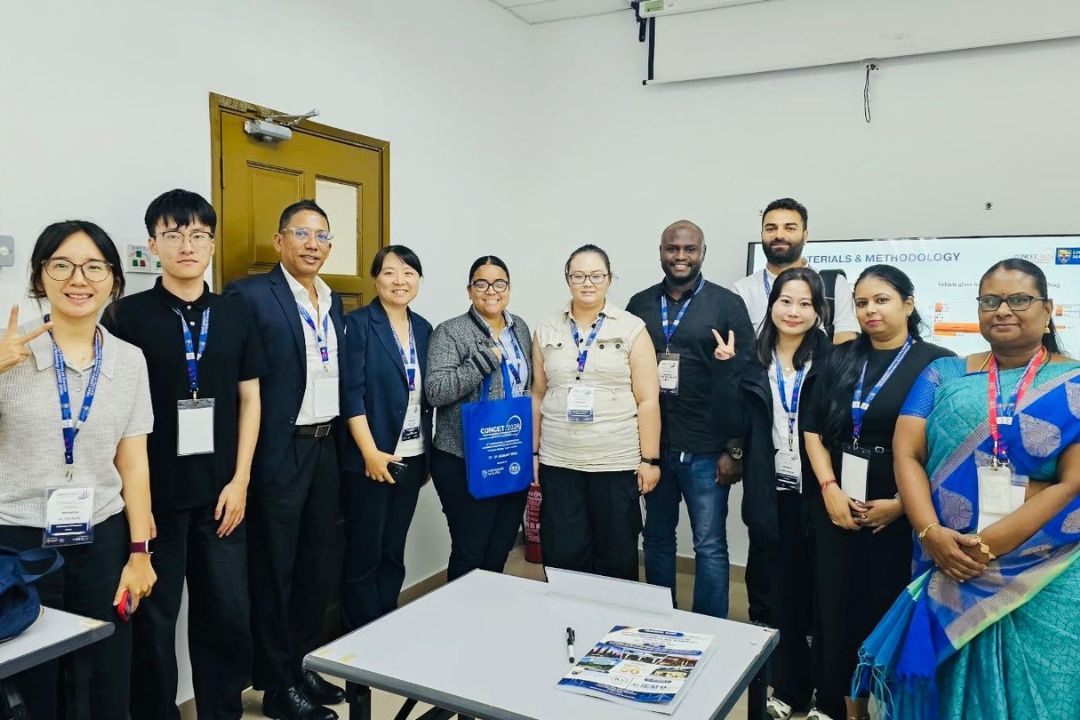


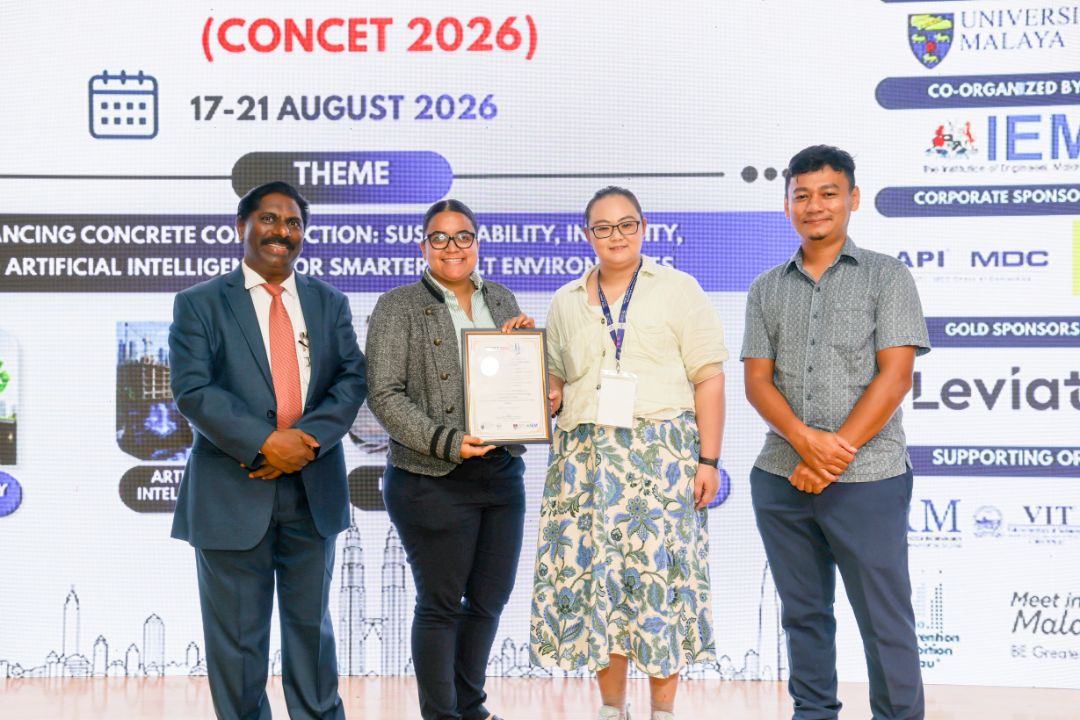
The participation of faculty members affiliated with the Escuela Superior Politécnica del Litoral (ESPOL) in the 17th International Conference on Concrete Engineering and Technology (CONCET 2026), held August 17–21, 2026, at Universiti Malaya, in Kuala Lumpur, Malaysia, earned the Best Paper award in the Geopolymers and Alkali-Activated Materials category, as well as the Best Presenter award, presented to Natividad García, Ph.D., a professor in the Civil Engineering program at the Faculty of Geosciences Engineering (FICT).
The Best Paper award was given to the paper “Statistical Analysis of Embodied Carbon and Compressive Strength in Geopolymer Mortars,” authored by Chenmeng Zhang, Dan V. Bompa, and Natividad García, Ph.D., and presented under the “Geopolymers and Alkali-Activated Materials” track. The research addresses the statistical analysis of embodied carbon and compressive strength in geopolymer mortars, with the aim of evaluating their mechanical performance and environmental impact as alternatives to conventional cementitious materials.
Participation in CONCET 2026 provided an opportunity to present and disseminate research findings related to the development and evaluation of alternative cementitious materials, particularly geopolymer mortars. In this context, the analysis of embodied carbon provides insights for assessing the environmental impact of construction materials, while the study of compressive strength allows for an evaluation of their mechanical performance.
Meanwhile, the Best Presenter award was presented to Natividad Garcia, Ph.D., in recognition of the quality of her presentation, her effective communication, and the clarity with which she presented the scientific results during the conference.
Receiving both awards strengthens the international visibility of ESPOL and the Faculty of Geosciences Engineering (FICT) in areas related to sustainable materials, geopolymers, and the assessment of the environmental impact of construction materials. It also highlights the participation of the institution’s researchers in international academic forums focused on the exchange and dissemination of scientific knowledge.
Related SDG:
SDG 9: Industry, Innovation, and Infrastructure, through the development and evaluation of alternative cementitious materials and innovative solutions for the construction sector.
SDG 12: Responsible Consumption and Production, through research into alternatives aimed at reducing the environmental impact associated with construction materials.
SDG 13: Climate Action, through the assessment of embodied carbon and the study of alternatives for construction with a lower environmental impact.